Tattoo Tarot: Ink and Intuition
Publisher: Laurence King Publishing Ltd. www.laurenceking.com
Year: 2018
Artist: Megamunden
Text: Diana McMahon Collis
My son and I were wandering around a mall recently when we stumbled upon a Spencer’s Gifts. Oh, what a world of naughty teen wonders! My son is sixteen now, so it’s not as though I was dragging a second grader through the store abusing his young brain with tee shirts and posters indecorously smeared with foul language, blushing innuendo, and side boob. The store bursts at the seams with that greatest of sartorial conundrums: vulgar tee shirts I find far too amusing that I would also condemn anyone for wearing. They are, as befits our subject, the poorly inked neck tats of the fashion world. While there, however, we wafted this way and that—as other scents wafted off other customers—until we came to the predominantly pink “witchcraft” (?) section of the store. In any case, the rhinestone encrusted chalices and pentacles did not say, “I want to know the Goddess within” quite so much as they said, “Dear Goddess, I hope my parents notice me.” But hold a moment, on the other side of the Pretty Pink Pagan aisle, a few tarot decks lay in wait.
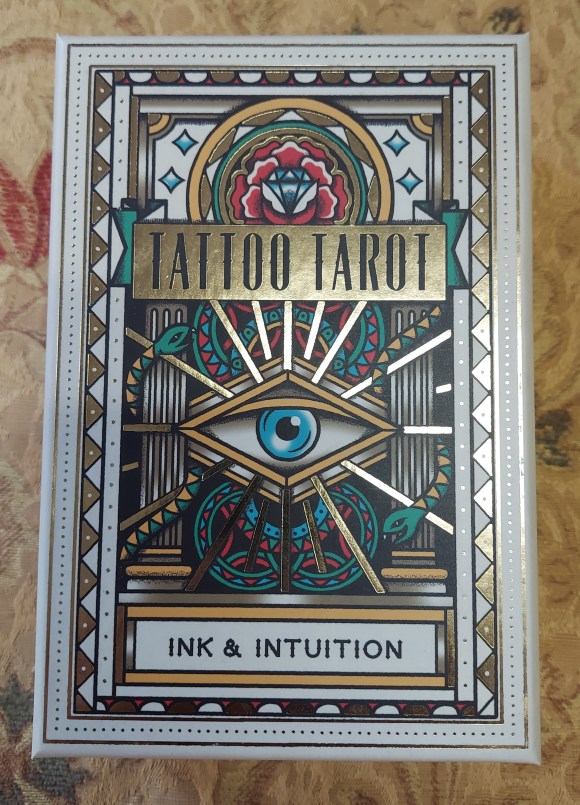
Dammit. They had me. I wanted to grab one of the overweight, over-pierced little whipper-shoppers and demand to tell her whether her boyfriend loved her or not, I wanted to take that greasy-haired, pimply-faced young man debating whether to major in philosophy or just to devote it all to the music and lay out those cards. Gods, the rush, man. After a minute to collect myself and my boy, I am glad to report that while so much of the store was appealing, my son and I left with not one item decorated with either a four-letter word or a marijuana leaf. I did, however, leave with the Tattoo Tarot: Ink and Intuition.
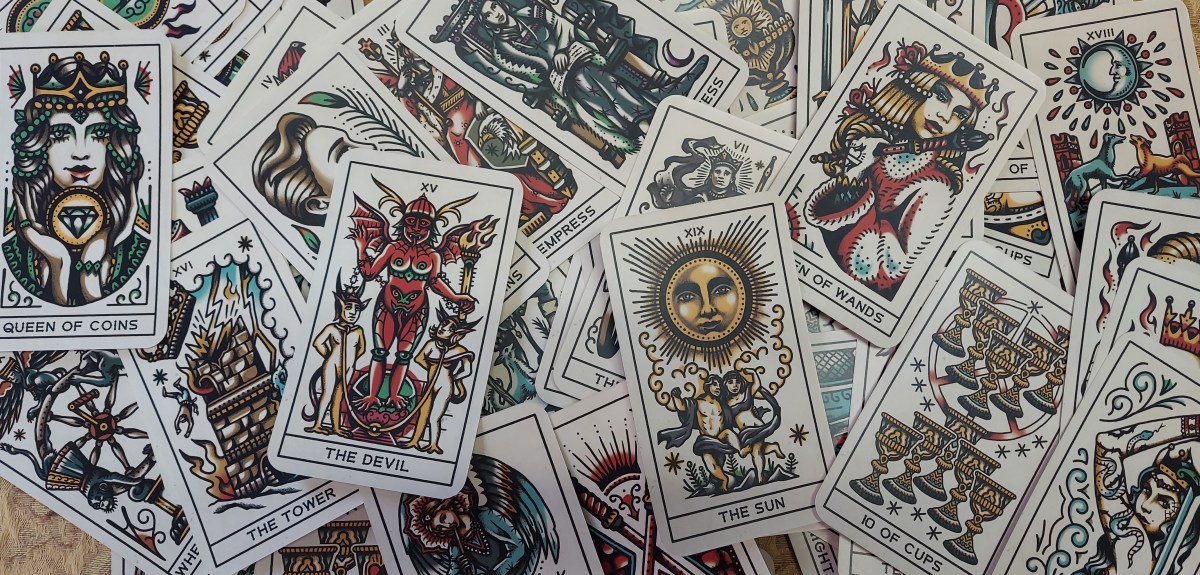
While the Tattoo Tarot: Ink and Intuition may not be the first tarot deck based upon tattoo imagery, I find it more artistically present, tattoo-forward, and coherent than other tattoo-based decks I’ve seen. The U.K.-based artist Megamunden has taken the cards in a wonderful direction; the bold, straightforward images pay homage to both tattoo flash imagery and the Tarot de Marseille (TdM). The packaging, a sturdy two-part box decorated with subtler tattoo icons surrounded by clean mid-fifties Art Deco lines and gold foil accents, is eye-catching even among a host of other eye-catching things.
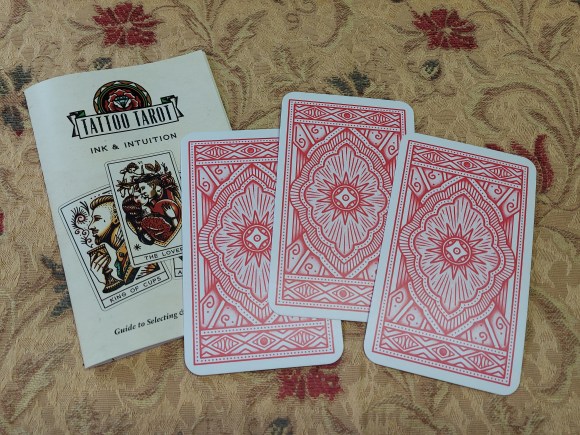
The LWB is a larger format guide written by Diana McMahon Collis, and in the introduction, she posits what I immediately noted as this deck’s strength: “In decks keen to preserve simplicity, alongside beauty, the clean lines of the traditional Marseille patterns feature across all the cards—as with Tattoo Tarot.” Additionally, she offers a brief look at the growth of skin art’s widening social acceptance. McMahon Collis also speaks to “conducting a reading” and “drawing and interpreting the cards,” and in these sections, one finds a nice give and take between the new practitioner’s needs to both use a resource for meanings while at the same time seeking more intuitive interpretations based on a more meditative, observant approach to the images.
She consistently emphasizes a respectful and positive approach to reading the cards. However, she suggests that readings are personal and for the use of the practitioner. “It is recommended to keep the focus on ourselves,” she writes, “noting information to help guide our own decisions, while being respectful of others’ privacy.” While I use the tarot for meditation and a type of personal spiritual structure, the interactive nature of the Practitioner-Seeker partnership means a great deal to me. Reading for myself is boring. One of the facets of the tarot reading that I appreciate and anticipate is getting “outside of myself” for a while and into the life/mind/thoughts/experiences of another. Tarot is a method of connection, both to ourselves and to others. And I’m from the Deep South…what is this “privacy” of which she speaks?
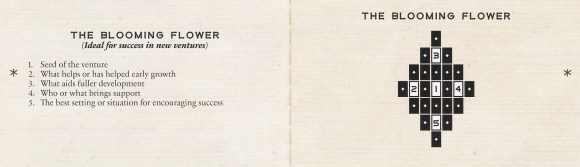
McMahon Collis also introduces several spreads I have never heard of. The spreads themselves are interesting, and I can’t recall ever seeing spreads where cards aren’t used, that is, cards are laid down in the spread but never read. In the spread she calls “The Blooming Flower,” out of twenty-five cards laid down, only five are read. I appreciate that the spreads almost function as a kind of additional shuffle, which I will come back to later.
The meanings of the cards are fairly standard, and perhaps it was the author’s emphasis on positivity that made her refrain from the “upright/reversed” meanings of most LWBs. In any case, I found that the pips actually fared better than the trumps in this book. The pips were rather specific in many cases, whereas the practitioner may be hard-pressed to distill something useful from cards like the Hierophant, which means, among other things, “Morality…Instruction. Philosophy…Impotence. Religious tyranny.” So my advice is, “Don’t talk to your priest about your E.D.” Maybe not. Overall, however, Diana McMahon Collis has produced a capable and gentle introduction to the cards.

Ah, but what about the cards? They are a fairly standard tarot size, only about three millimeters wider and taller than the RWS, but the stately and stylized images make the cards feel even larger. I would mention too that the titles and the numbers are clear and prominent on the cards and meld well with the clear expression of the images. (And breaking with Marseille tradition, Trump XIII has a name.) We also see the subtle nods to other tarot traditions as well: the Fool’s dog appears “inspired” by Pamela Coleman Smith as is the enigmatic stance of the Hermit. Nods aside, the largest influences by far are the foundational images of the Tarot de Marseille. The Tattoo Tarot is an extraordinary artistic reinterpretation of the classic deck.
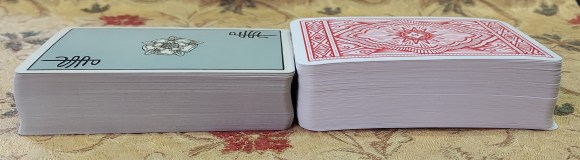
The cards themselves feel wonderful. The cards are matte on thin cardboard, but that thin cardboard still means that the deck is nearly a full centimeter taller than a standard RWS. The very cardboard nature of the cards gives them a wonderfully tactile surface and reminds me of the Hoi Polloi Tarot from the seventies, but with better production values. The cards are a bit stiff, and they did come out of the box with a definite bow; however, it’s nice to see that since they have been sitting around my office, they are beginning to flatten.
In addition to the feel of the cards, they are beautiful. The images are the kismet blending of two imagistic systems that I never knew could work so well: the Tarot de Marseille (TdM) and the traditional tattoo style of the early-to-mid-twentieth-century. The style of the tattoos is clean and strong and in vogue once more in the early twenty-first century. Megamunden, with whom I am admittedly unfamiliar, has bridged that artistic gap in a magnificent fashion, and I am sure that the not-insignificant overlap of tarot and tattoo enthusiasts are placing these images on their bodies. The trumps are a visual accomplishment, at once staying very true to their Marseille origins while at the same time giving the Reader something new: the more pensive look of the Fool, the roses on the Hanged Man, the tatted Star.
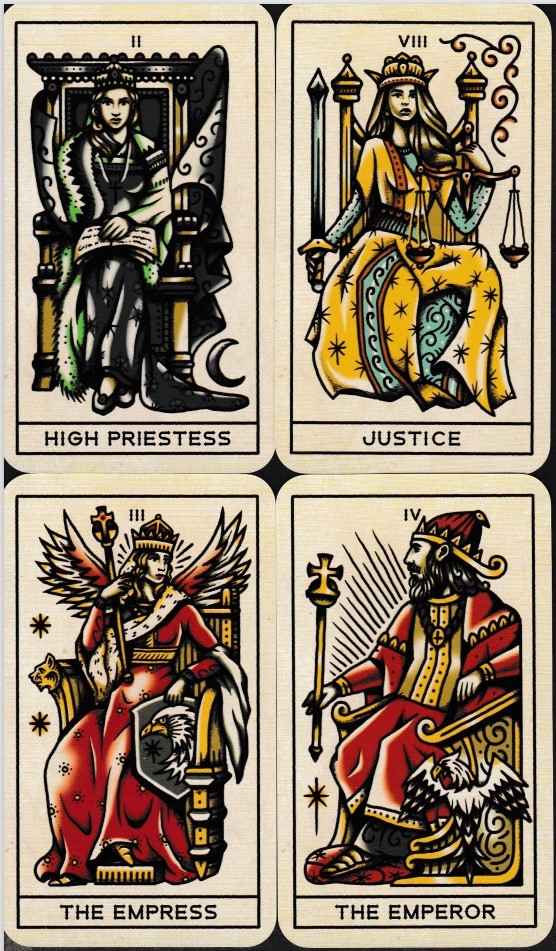
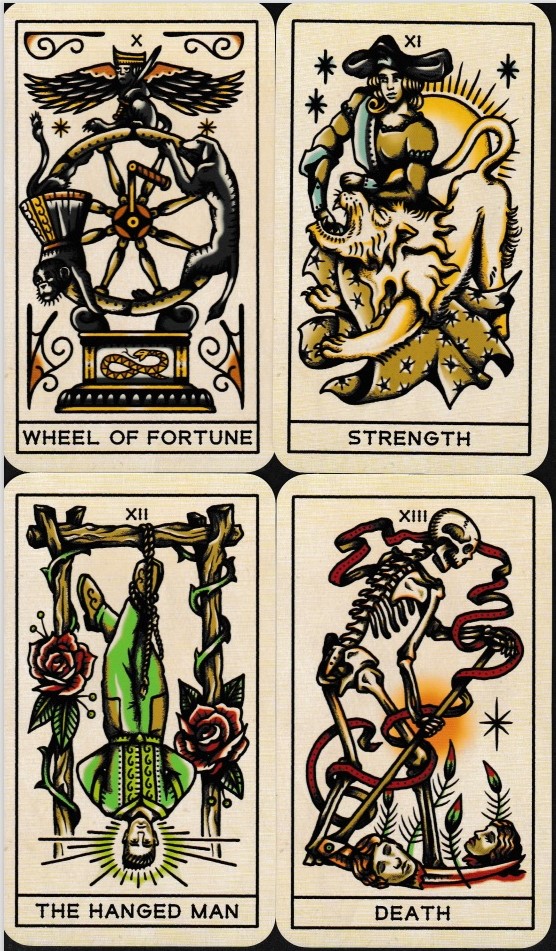
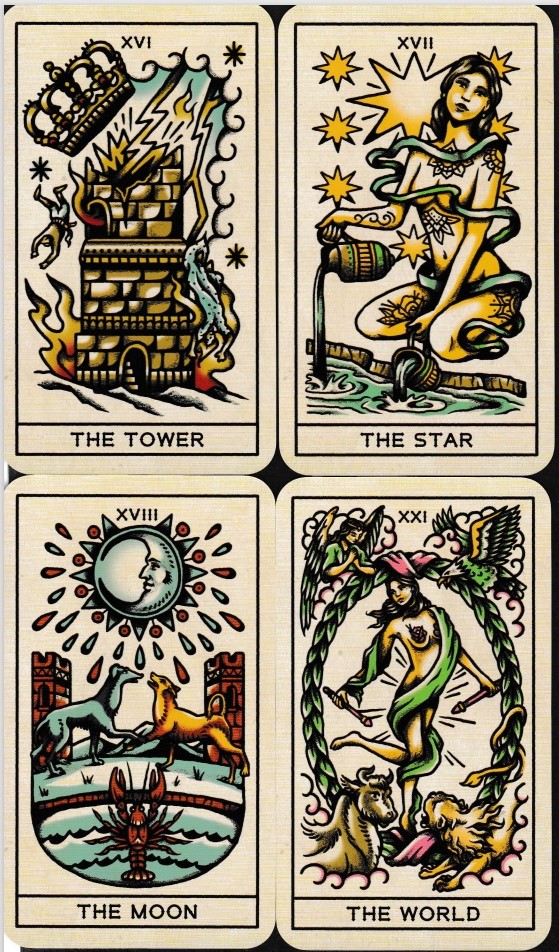
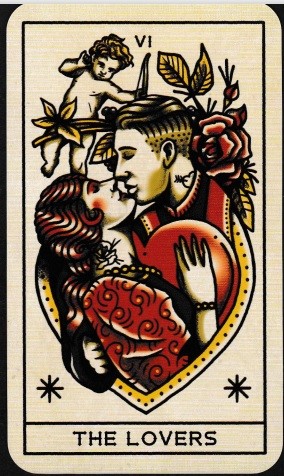
The linework and coloration of the deck are exquisite. On the back, the artist gives us beautiful, reversible red linework reminiscent of traditional playing cards. On the front, the palette of the deck consists of six colors, black lines, and white spaces. The limited color scheme and strong lines give the deck a beautiful, unified look. The colors themselves are lush and dark, warm and inviting. While I understand that they may be a bit dark for some, the artistry is evident and the tattoo theme on full display. The classic tattoo style also lends the cards a kind of paradoxically antiquated feel. The Lovers, in particular, strays from the more traditional imagery (and I am glad of this) to become the grand, fairy tale love between a flapper and the dapper. With little alteration, my grandfather may have come back from WWII Europe with this image on his person. (He chose instead a similarly themed naked lady on one arm and an enormous military eagle across his chest.)
In fact, throughout the deck, I find a very sensuous quality, not just to the cards, but the images. The women tend toward the powerfully beautiful, statuesque and strong. Various trumps, and the Queens specifically, exude a magnetic “Roaring Twenties” flirtatiousness that is captivating. The men evoke feelings of more modern advertisements; they are less stereotypically masculine and more aligned with the Hipster aesthetic; they are men, certainly, but I suspect many of them would be content smelling of expensive cologne, being vapid and pretty. This is not a criticism, by the way. The King of Cups, my usual significator, and I are practically twins. If it weren’t for the King’s coifed blond hair, youth, and slender good looks, it would be like looking in a mirror.
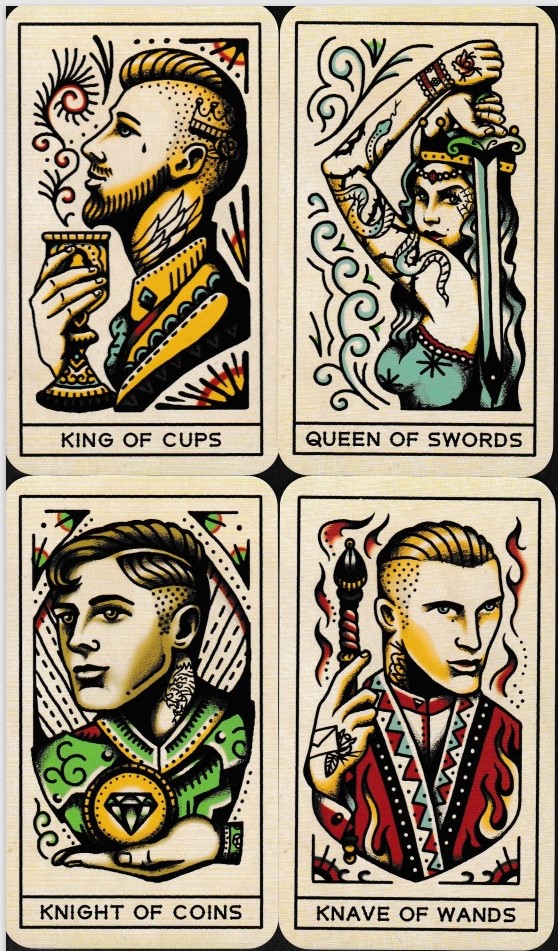
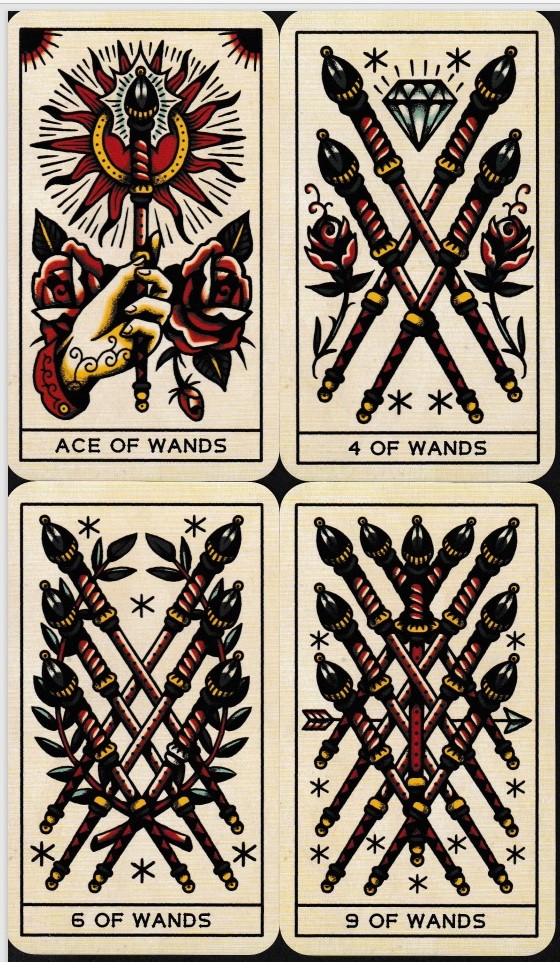
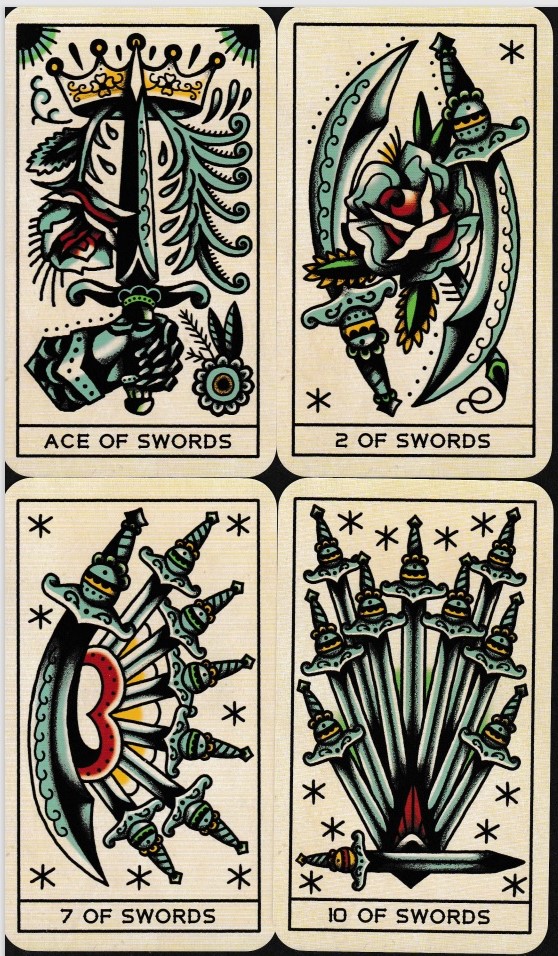
The Minors too owe a quintessential debt to the Marseille, but Megamunden teases at the cards’ meanings within the images. The Knave of Wands means “News and announcements. Messages arriving” (McMahon Collis), and so he has a tattoo of a letter on his right hand. A wreath of victory is interwoven between the wands on the Six. The middle cup on the Five of Cups is being filled by a crying eye. The Eight of Coins, representing ideas and industry, show one coin decorated with a lightbulb and another emblazoned with a hammer and anvil. These visual clues are certainly not in traditional Marseille style cards, but I, for one, adore these little hints. Also, rather than stylizing the swords into unrecognizability, the artist has fleshed out the traditional images to great effect by using various combinations of straightswords and scimitars.

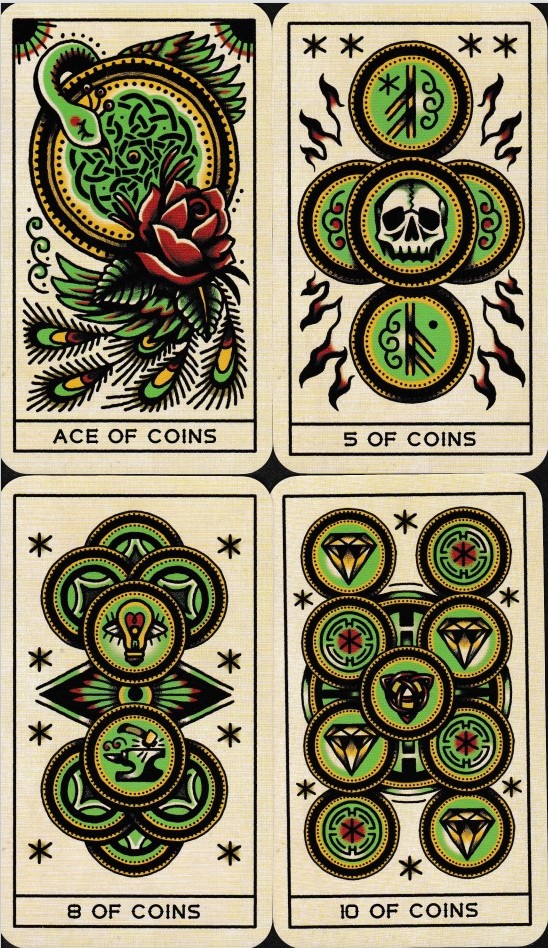
Are there any drawbacks? Is this the perfect deck? Well, no. Besides the fact that the perfect deck is a myth, I do feel the need to mention the fact that these cards are almost impossible to shuffle. I have already admitted my fondness for their tactile nature, but unfortunately, the cards do not glide over each other at all, and the cardboard of the cards themselves makes riffling difficult to say the least. The cards are thick, unyielding, and unwieldy. The last time I tried to use them, my inability to comfortably shuffle the cards in any way made me give up and grab another deck in frustration. While I am sure that with enough use, they will begin to become more usable, they do not come out of the box that way. Otherwise, however, they are a delight, and I am glad to add them to my collection.
To end, I will say that as for me and mine, we are not an overly tatted bunch: Wife has only one, Daughter 1 has three, and Daughter 2 has four. Daughter 2’s fiancé is in the low double digits. My son is sixteen, but says he has plans, and I have two: Pamela Colman Smith’s Sun on my right shoulder and her Moon on my left. I take my tarot very seriously. Again, writer Diana McMahon Collis and artist Megamunden are to be commended for this warm and inviting reinterpretation of the traditional Tarot de Marseille. The artist and designers of the deck hit just the right notes between classical references and modern aesthetics.
 The Tarot King of Mississippi