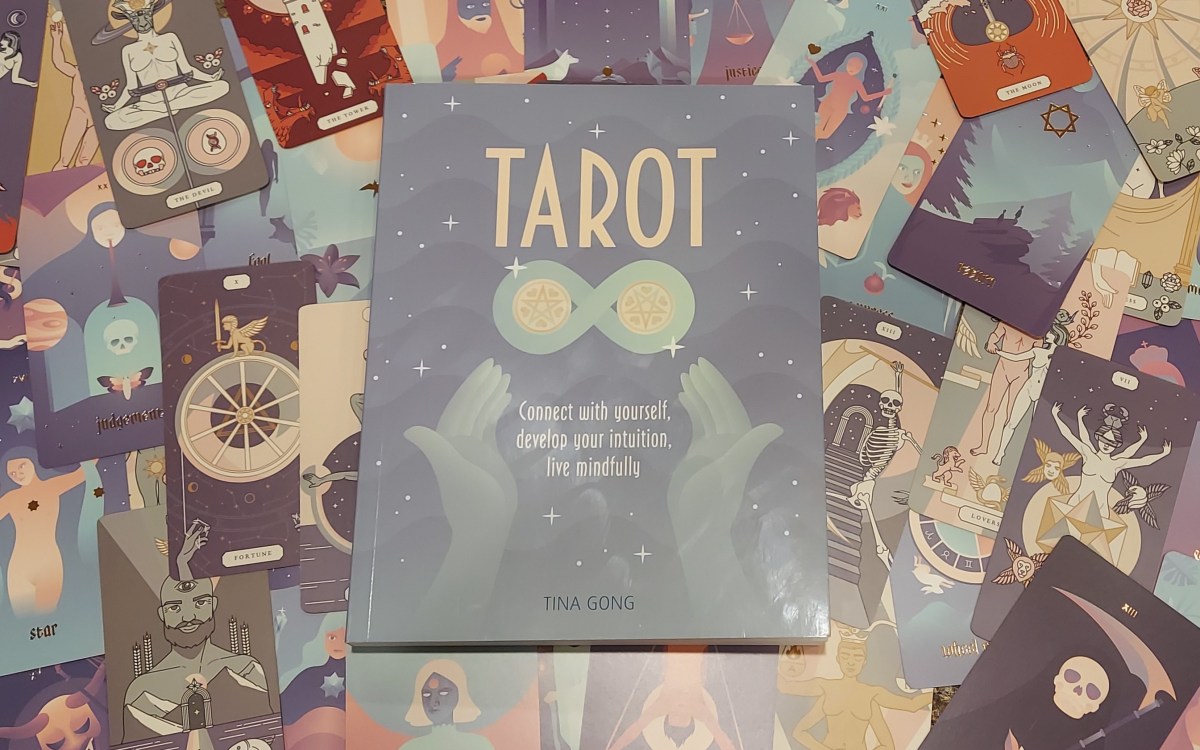
Book: Tarot: Connect with Yourself, Develop Your Intuition, Live Mindfully
Author: Tina Gong
Publisher: DK, Dorling Kindersley Limited, a division of Penguin Random House.
Some months ago, I ran across a random, but pleasantly illustrated book on tarot. This is generally not my practice as “information” and “illustrations” do not generally go hand in hand. One is reminded of so many science-fiction and fantasy books of the seventies, eighties, and nineties whose covers were painted by the incomparable Boris Vallejo. I have been a fan for decades, but no one’s art more skillfully says, “I never opened this book.” Be that as it may, the price was right and the book itself was simply lovely. At the time, I am sure that I was looking for something calming to distract me from what was at the time our impending first grandchild (Since November, he is no longer “impending,” just adorable). The soft tones of the cover and the equally tranquil card images found within were the perfect balm for my tension. I assumed that I could breeze through the book as an effortless distraction, so I was completely unprepared for this little treasure. Without reserve or hyperbole, Tina Gong, both author and illustrator of this book, has created one of the best introductory texts to the tarot I have ever read.
Tina Gong’s voice in Tarot: Connect with Yourself, Develop Your Intuition, Live Mindfully is quiet, but knowledgeable. The first main section of the book is entitled “Reading Tarot.” Within the paragraph underneath the heading, Gong gives us what I feel is the thesis of the entire work: “Reading the tarot involves a combination of using your conscious desire to search for truth, meaning, and purpose alongside your ability to listen to and interpret the voice of your unconscious, which finds its mirror image in the cards” (13). Such beautifully worded sentiments as these are found throughout the book. Don’t skim this book. Read it.
Another aspect of the book that appealed to me was a strange sense of connection. If this book is Gong’s exegesis of the tarot, then she and I share a truly parallel perspective of this remarkable medium. The two-page section entitled “Tarot and Mindulness” is such a beautifully simple, lucid explanation of my own experience with the cards that I can only mutter, “She gets it,” like a gobsmacked teenager.
Also within the first section, Gong breaks down the tarot into its component parts, both traditional and modern, but even this vivisection is so well thought-out and organized that I just looked at it in awe. Her take on the structure of the tarot does seem a combination of old school Golden Dawn or Crowleyan categorization coupled with a much more up-to-date psychoanalytic and self-reflective approach, but then her words are aided by the visual presentation. Everything about this physical book—illustrations, layout, size, even font—is geared toward the soft illumination brought to us by Ms. Gong. I had the impression of reading a book that was being whispered to me.

Gong’s language is so simple, so straightforward and welcoming, that my greatest critique—even accusation—is that she makes the tarot seem as simple and as easy to read as her book. Certainly, this deception is unintentional. One of her plans of action associated with the Ace of Cups is the following: “Challenge yourself to understand where your feelings are coming from and what actions your emotional self wants to take. Allow yourself to be led by these feelings and see where it takes you.” Oh, well, sure. Of course. I can only assume that a writer of Ms. Gong’s gifts realizes that this unaffected advice can take people literally years to learn how to follow. I am only learning now, and I am staring fifty in the face.
Otherwise, her ability to tease out the layers of the deck is unsurpassed. She divides the Trumps in a Plato-cum-Jung fashion, separating the Fool (Trump Zero) from the other twenty-one trumps and then dividing those remaining trumps into three groups of seven: the Conscious Mind (Trumps I through VII), the Unconscious Mind (Trumps VIII to XIV), and the Superconscious Mind (Trumps XV through XXI). The divisions line up remarkably well with the Neoplatonic groupings that Robert M. Place identifies in his book The Tarot: History, Symbolism, and Divination. Another area of great compatibility is Gong’s explanation of numerology in relation to the Minor arcana (16-17). Her keywords related specifically to the number of a card—the fives representing challenges brought about by leaving the stability of the fours, for example—dovetail seamlessly with the personalities of the sephiroth established in Hermetic Qabbalism.
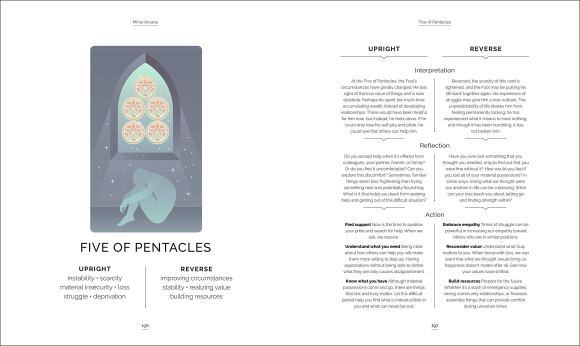
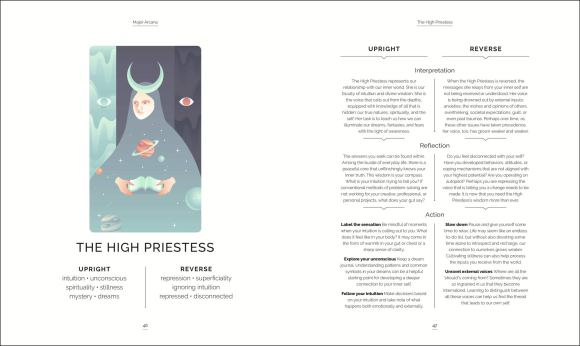
So too with reversed meanings. When one gets to the “meanings” section of the book, we see each of the seventy-eight cards given a two-page layout wherein the reader is given both upright and reversed information for each of four categories: Keywords, Interpretation, Reflection, and Action. Again, I cannot praise enough both the organization and the language of this book. Gong is a skilled author who creates truly meaningful and distinct interpretations of all these cards. There is no linguistic filler or woo-woo doublespeak to obfuscate her interpretation of the essence of the card.
As for the meanings, while the book is beautifully illustrated with Gong’s own version of the RWS, her delineations of what various cards mean or what questions one should ask oneself when dealing with this or that card can have a subtly Crowleyan undertone. For instance, Gong does give reversed meanings for cards, but given Gong’s intensely holistic view of the cards, I got the overwhelming sense that literal reversals almost did not matter since, as Crowley posits in his own Book of Thoth, every card contains everything associated with that card, good and bad, regardless of its physical orientation in a spread.
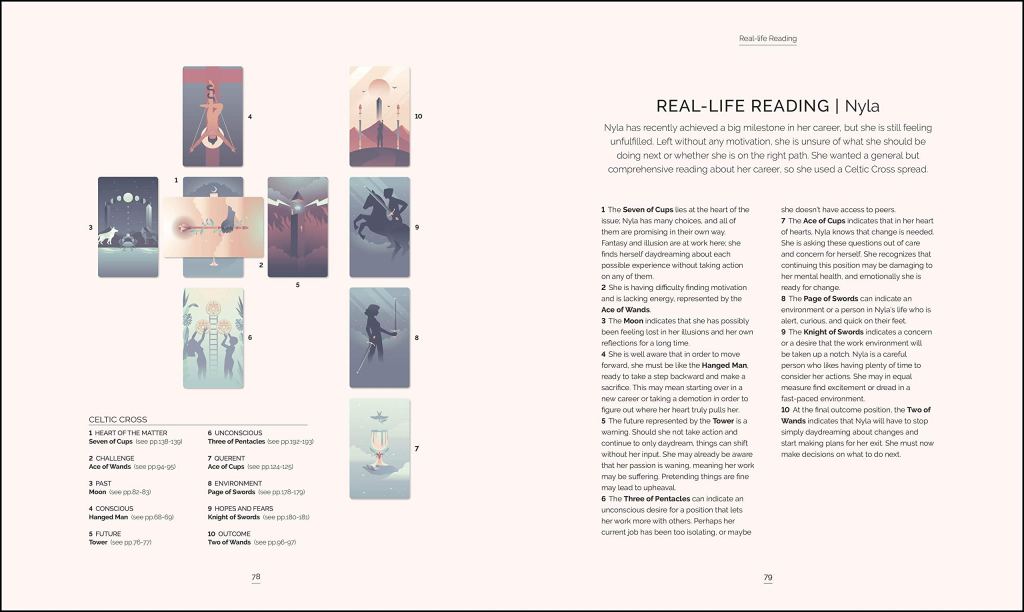
Speaking of spreads, she gives in abundance. Ten pages of the book are devoted to card spreads, and Gong wastes not a word. The two pages devoted to three-card spreads alone is so extensive that it warrants a second and third look, and she only goes up from there. In addition to the spreads, Gong also gives examples of real readings throughout the book, which are very well done. I always enjoy a practitioner going through the reading, helping the more literal reader of the book see the process. And just like the rest of the book, Gong takes us step-by-step and card-by-card through the readings. I recall a couple of other books, for example, The Original Tarot and You by Richard Roberts, where “real readings” are part of the narrative, but almost without fail, the author will get to a card or position in a reading and make an unimaginable leap of logic that leaves the reader scratching his or her head. To her credit, Gong is calm, methodical, concise, and consistent.
Initially, I thought that I might have had a critique. I would have liked to see more astrological symbolism or referents, but even as the thought occurred to me, I immediately understood why this aspect of the cards was, not neglected, but edited. For all the Hermetic influences that I may project onto Ms. Gong’s book, she has wisely chosen to provide a more modern, associative take on the archetypal trumps and courts and a far less cumbersome numerological and elemental mnemonic for the minors. She has deftly avoided much of the extravagant—I daresay “overwrought”—symbolism of older Victorian “mystical” systems (which, with a wink, still happen to work quite well with everything in the book).
A mass-market version of the Seventh Sphere (RWS)Tarot is used to illustrate the book, which appears to have a few editions. The book I bought (in the main image of the review, lovingly surrounded by the Seventh Sphere Marseille and Arcana Iris Sacra tarots) is a paperback that is the same size and content of every other version I have been able to find, but the ISBN turns up no results. Amazon sells the hardcover version of the book alone, but to my knowledge, the only way to get the cards as they are in the book is to get the book-and-deck set from Barnes and Noble. Of course, Tina Gong is the driving force behind the website Labyrinthos.co, and the intriguing Seventh Sphere Rider Waite Smith Tarot (the fancy foiled and gilded version of the deck in the set) or Seventh Sphere Tarot de Marseille are just a click away. Soon (whatever that may mean), I will post a review of two of Tina Gong’s tarots: the Seventh Sphere Tarot de Marseille and the Arcana Iris Sacra. Until then, I would like to thank Tina Gong for the unexpected joy that her tarot tome—a new standard in the field—has brought me. I eagerly await whatever she has in store for the future and am truly grateful for her contributions to the world of tarot.
 The Tarot King of Mississippi