I generally try to keep my harsher opinions to myself. Every now and again, I slip. A few weeks ago, the United States Supreme Court rescinded its decades-long support of the landmark Roe vs. Wade decision, which granted legal access to abortion services across the United States. I was making a small repair in one of our main work areas when one of my coworkers heard the news. She turned around with a triumphant grin on her face and said, “Praise Jesus! Roe versus Wade has been overturned!” She even went so far as to shake her hand in the air, a little “way to go” gesture that really drove her emotional investment home. Another woman in the room joined her—albeit less enthusiastically—with a similar gesture of accord.
Before I had considered what I was saying, I blurted out, “You know that this is not good news, right?” She looked momentarily stunned. It was a look, a sentiment, that I see far too often here in Mississippi, but also in reports and pictures from Washington, D.C., and in articles from all over the world. My coworker, like so many other politicians and religionists across the world, simply could not comprehend that someone believed differently than she. “What do you mean” she asked already indignant that I, twenty years her junior, would have said anything in the first place. “This is probably going to cause more problems than it solves. Especially here,” I replied. “Well,” she retorted with a sterner tone, “I still think it’s great.” “I’m glad you do.” And with that, I left the room; the conversation, over.
Later in the day, when there were only two of us in the room, the younger woman who had earlier voiced assent with our coworker says, “Can I ask you a personal question?” “Certainly.” “Are you an atheist?” I have written before on this particular conundrum. The people by whom I am generally surrounded have only two options for any question. What she was actually saying without saying was this: “I noticed that you disagreed with the Baptist earlier, so you must be an atheist because those are the two choices here.” To her query, I very politely and sincerely answered, “No, I am not, but…I also know for an absolute fact that humans and chimpanzees share just over 98 percent of their DNA. Those numbers suggest to me that I am not going to take any human’s word for knowing the mind of God.” She smiled and made a satisfactory noise in her throat. She looked up at me, still smiling, said, “Gotcha,” and went back to work.
Unfortunately, this awkward series of exchanges at work is the larger crisis in miniature. Mississippi is one of the thirteen states that had “trigger laws” pending Roe v. Wade’s invalidation. This means that, years ago, the state of Mississippi put on its books that if Roe v. Wade were ever overturned, abortion would become illegal in Mississippi almost immediately. The overturning of Roe v. Wade would “trigger” that new law. And so it did. Mississippi’s sole abortion clinic, located in our state capital of Jackson, was closed within days. The building itself was sold within a day. When the doctor who owned the clinic was asked by a local media outlet how she felt about the sale, she tersely and accurately answered, “I don’t care.” People actually wonder why constant beratement and mutual incomprehensibility generate such Spartan responses.
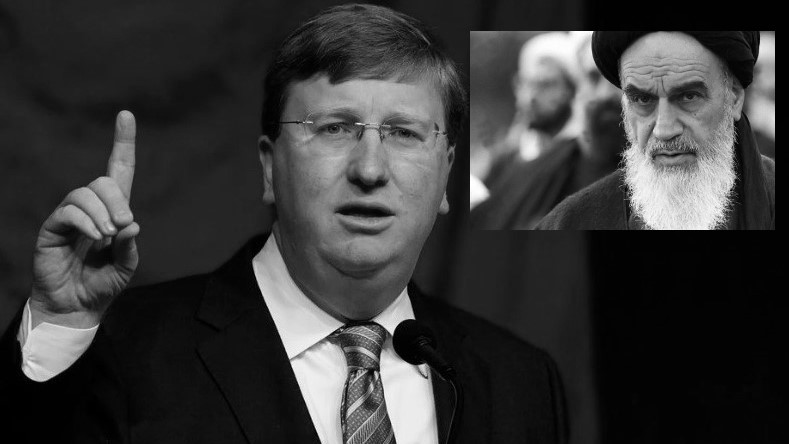
Within hours of Roe v. Wade’s legal demise, our governor and others of his ilk were proudly proclaiming on social media and local news outlets that they were thrilled with the Supreme Court’s decision and that they would fight to maintain the traditional Christian values that make our state so great. On Twitter alone, he wrote that he is “creating a culture of life in our state and across the country” (22 June 2022). A few days later, he posted Deuteronomy 30:19 in full above a meme of his own quote: “This decision will directly result in more hearts beating, more strollers pushed, more report cards given, more little league games played, and more lives well lived.” For some, this may prove exactly why he wants to end this practice, but I get the impression that he doesn’t know who gets abortions. What part of Mississippi is he talking about? How many knocked-up fifteen-year-olds are thrilled about a new stroller? And she can’t help her child get a good report card, Governor, because her child is as poorly educated as she is. Is the little tyke’s dad going to take him to that game? Really? Mississippian “lives well lived” tweeted by a man who has never had to drink the brown water straight from a tap in our capital of Jackson. A few days later, he tweets, “When they try to take prayer out of our society, they are trying to undermine our foundational principles.” And on June 29th, he “declared June to be Sanctity of Life Month.” And for over a month, I have tried to wrap my head around everything that is happening.
I have been struggling to put a focus on my general dismay. For my Dictionary of Uncommon Knowledge, I came up with this definition of my state: “Mississippi” (n) (pronounced Miz-sip’-pi by natives or referred to simply as “The Sip”) (1) a small, educationally and economically depressed Protestant Christian theocracy located in the Deep South region of the United States. Mississippi was admitted as the twentieth state in December 1817, then grudgingly readmitted shortly after April 09, 1865. (2) The river to the west of the state. The American Native word means “Father of Waters,” though many suspect now, far too late, that it may have meant “Keep rowing.”
Even to myself, I neglected to notice the real problem about what I had written.
Then it happened. On August 12, 2022, in New York, Hadi Matar rushed the stage and stabbed author Salman Rushdie as he was preparing to give a talk at a college. Rushdie was stabbed between ten and fifteen times. At the time of this writing, Rushdie is off the ventilator, and reports suggest that he is on the mend; however, there is also speculation that he may lose an eye, that his speech is affected, that he may lose motor function in one arm, and that his liver has been seriously damaged in the attack. Matar, whose attack is captured on video and was physically pulled off of Rushdie by onlookers, pleads “not guilty.”
We do not know the motives, and I would not attempt to ascribe them, but I did have a visceral reaction to the attack, a reaction that took me by surprise: a perfect storm, as it were. For years, I have been an admirer of Salman Rushdie, both his work and the generally pragmatic outlook that he presents in interviews and print. I respect his opinions, and his literature creates one of the most beautiful and magical worlds in which to live. He forever plays with the idea of perspective. In his novel Midnight’s Children, for one small example, nothing particularly magical happens, but that doesn’t stop anyone in the book from interpreting those events in a magical, portentous way. His telling of that story situates the reader at the fulcrum of faith and fact, seeing both, not having to choose. His work allows us to see the magical in the quotidian, in the dirt-covered masses, in all the world around us.
I did not know how grateful I was for that perspective until I burst into tears upon learning of his attack. I remember when the Iranian Ayatollah Ruhollah Khomeini, stern and paternal, issued his fatwa in 1989. On my grandparents’ enormous wood-grain, floor console television, the Ayatollah’s dark, unflinching eyes seemed to float above and outside of the sunken cheeks and columnar beard as he stood on a balcony surrounded by banners, many of which had his face on them. At the time, I could not understand the implications of the act: a politico-religious “supreme leader” declaring an author, a writer, to be an enemy of the Islamic state and religion. I remember the clatter of the era as Rushdie fled into hiding after several of the book’s translators were injured or killed all over the world. As a naïve American and further sheltered by the militant backwoods nature of my Mississippi upbringing, I could not fathom what had happened. America did not do things like this. America did not quell the opinions of our writers. These acts were foreign to me.
Over time, of course, Rushdie would come out of hiding. With some confidence, I concluded what I think many people assumed, that the Islamic or Iranian furor over the author’s existence had abated over the three decades since Khomeini’s pronouncement. How wrong, how naïve we all were. And how Salman Rushdie will now suffer for our lack of vigilance, for our assumption that such a deranged and persistent evil would ever truly sleep.
I think that the formally Islamic state of Iran and the informally Christian theocracy of Mississippi would be surprised to learn how similarly they try to operate. Certainly, I am not so deluded as to believe that the political actions or ridiculous tweets of my hokey governor would ever carry the decades-long impact of the late Iranian ayatollah, but it doesn’t stop him from trying. The highest-ranking politician in our state actively ridicules those of us who hold non-conformist views and then we are called to defend ourselves against NOT believing ancient Middle Eastern mythology. It staggers the mind to see the degree to which religious people will abandon the most basic principles of logic, reason, and simple respect simply so they can defend the direction the butcher faces when preparing halal meat or “what a rainbow means.”
I used to be Mississippi’s biggest cheerleader. I knew in my heart of hearts that we could change. I don’t think that any longer. Mississippi will never change, and we will fight for the bottom every time. I am not suggesting that people give up their religions, although I could certainly support the idea, but is it too much to ask that people in public service keep their religion to themselves, that they not call us heretics who would not see their beliefs codified into law? Is it too much to ask that politicians praise God in their homes and churches, but not to quote the Bible from the steps of the Capitol? If the governor of the state, living as well as he does off of the dwindling public weal, chooses not to get an abortion, please laud him. He does so live for the petty adulation. But we should all bear in mind that one’s spiritual autonomy ends with a single person. Leave me alone to live my life without constantly being told that we need God back in schools or that we need to pray before every high school football game. Just stop.
Why does a vicious attack on a world-renowned Kashmiri author suddenly sharpen the focus on the trigger laws of America’s least respected state? Because theocracy is evil. Simply evil. And it does not matter whether the Islamic Ayatollah of Iran decrees that Salman Rushdie must die or that the United Methodist governor of Mississippi decrees that any lump of germinated cells must not. To rule from the pulpit, with the primate assuredness of God’s will on your side, is to instigate hatred, pain, and restrictions of all kinds. For literally millennia, the Roman maxim “Vox populi, vox dei” (The voice of the people is the voice of God) reminds us unambiguously that gods can and do disagree on a host of very serious matters. And in the seventeenth century, when the state of Massachusetts killed Quakers because being a Puritan was necessary to live there, the United States as a whole eventually decided that this was not a good way to run the country. It’s still not.
 The Tarot King of Mississippi
2 replies on “Apostasy in the Hospitality State, or How Rushdie Helps Me See Mississippi”
i am reading this so many months later, but your thoughts moved me and i wanted to say that they did. mariame kaba says “hope is a discipline” and my father always said “the struggle continues,” and it is what i try to remember when current events break my heart. change isn’t linear and the struggle for liberation from any kind of oppression is a marathon, not a sprint. your thoughts and presence make a difference, even if you think things will never get better, and while we might not see all the fruits of our efforts in our lifetime, future generations will be grateful that we never stopped struggling.
LikeLike
My goodness, Jacqueline! Thank you so much for your encouraging words, and they came at such an opportune time. More than one person of late has reminded me what a mood I’m in, and it hasn’t been good. I love the quotes, and they both remind me of Classical Stoic pragmatism: The struggle is what it is, but the mindset can certainly make the struggle harder or easier. In any case, thanks again, and I will just have to keep running that marathon! All the best to you and yours, Robby.
LikeLike