Writer/Artist: Tina Gong
Website: www.labyrinthos.co
Recently, I reviewed another one of Tina Gong’s productions, her book Tarot: Connect with Yourself, Develop Your Intuition, Live Mindfully, of which I am a great admirer. Prior to the book, I had already purchased the Arcana Iris Sacra Tarot on a field trip from my Mississippi digs all the way over to Birmingham, Alabama. In the smaller area of Homewood, Alabama, one finds a lovely little witchy shop called Ritual+Shelter (Instagram: ritualsheltershoppe). As guests enter their charming store, a quick glance to the right introduces them to the tarot wall that I want in my home, decks and books from practically floor to ceiling and from the front of the store almost to the back. I was uncharacteristically giddy the first time my friends brought me to the store. Visiting the store or chatting with the helpful, knowledgeable staff is always a lovely experience, and I hope that I shall soon find time to run in again.
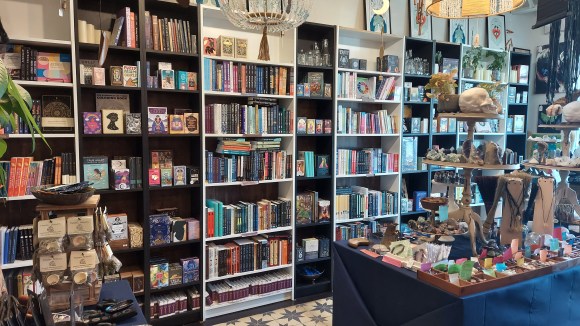
In any event, the Arcana Iris Sacra (AIS)was already on my radar when I saw it and its sister deck, the Seventh Sphere Marseille, on the shelves at Ritual+Shelter. I was able to flip through the display decks, and I left with both of them. The AIS is a Thoth-based deck, which is always going to get my attention, but Ms. Gong certainly has her own artistic voice in interpreting the images originally produced by Crowley and Harris. The AIS is a distillation of the Thoth Tarot; much of Crowley’s heavy and overlapping symbolism has been removed and replaced with an orderly, Spartan imagery that infuses the deck with a consistent, meditative feeling, which is, at times, in direct opposition to the crackling energy of Harris’s original watercolors.
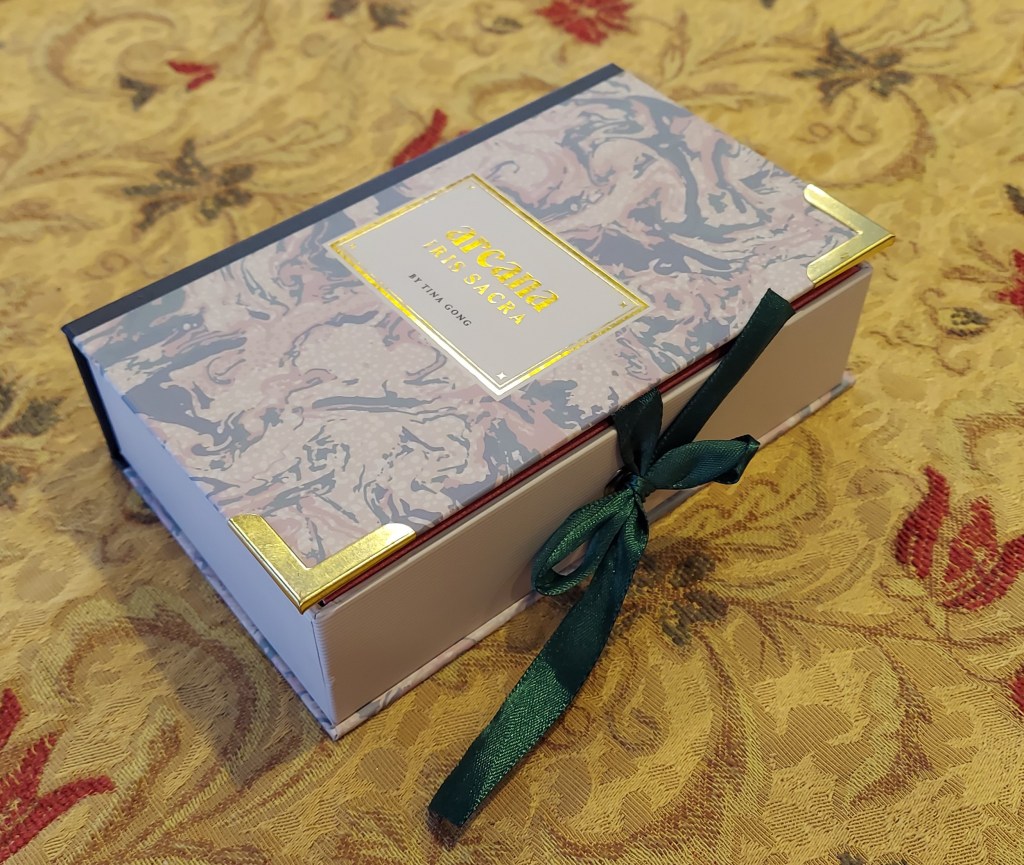
The production quality of the AIS is absolutely top-notch: the well-made cardboard box mimics a small book, accented with a green tie and metal corners, and is colored to match the back design of the deck. The “LWB” is not a Little White Book at all, but is a single piece of folded vellum-feeling paper. Though I don’t often have a feeling one way or the other with regard to LWBs, I do appreciate Gong’s brevity here. As I have already mentioned of her book, she truly has a talent for choosing the absolute mots justes. The author uses a series of quick keywords for each of the cards, keywords which seem efficient rather than terse, and while thirty-six of the cards already have descriptive titles on them, she never repeats their titles in her descriptions. Her use of space is so tight, so lean, that she still has room to introduce the reader to two spreads (a three-card and a classic Celtic Cross) on that same single piece of folded paper.
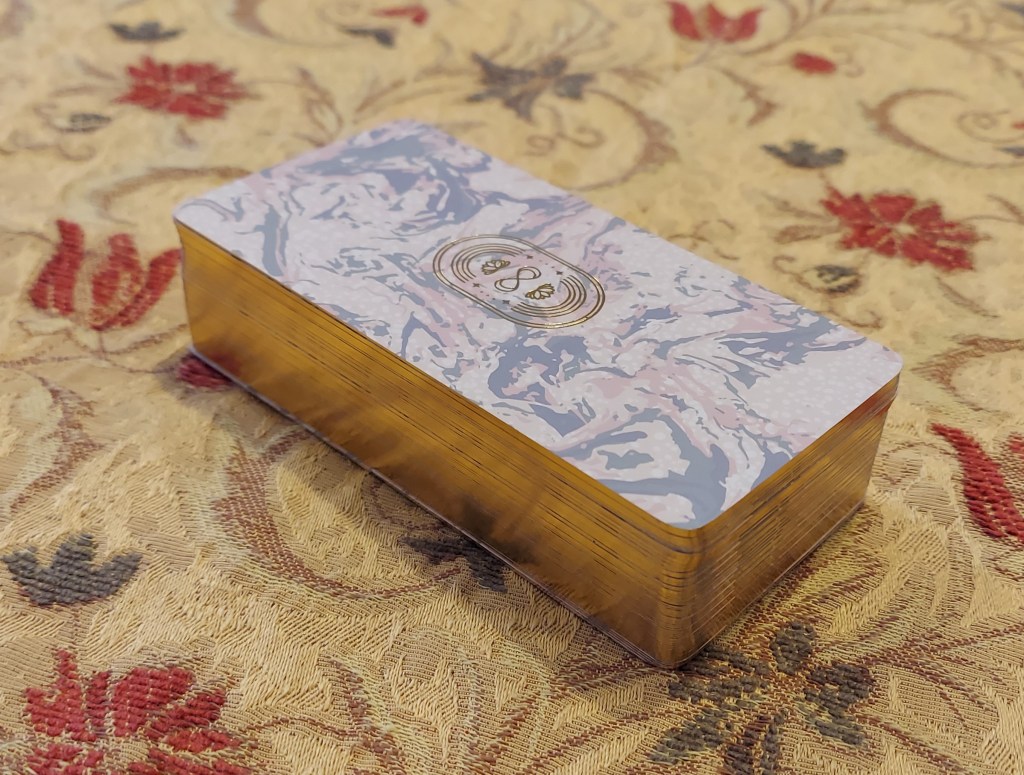
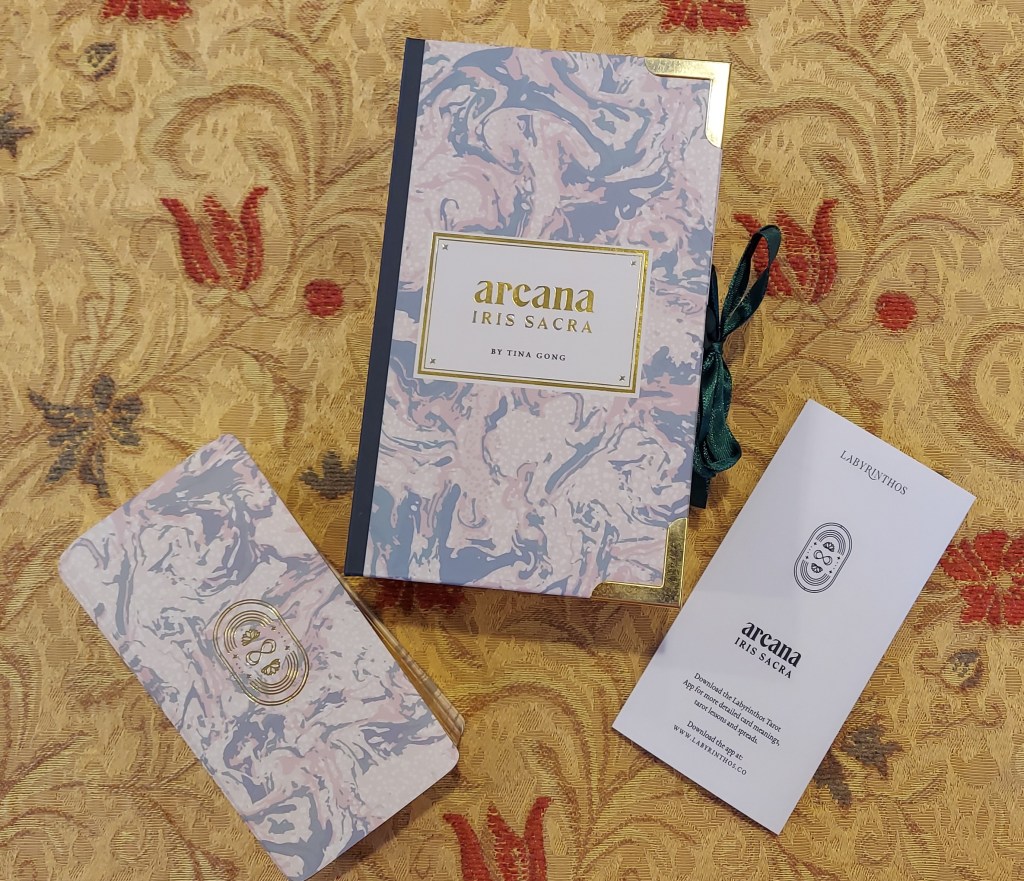
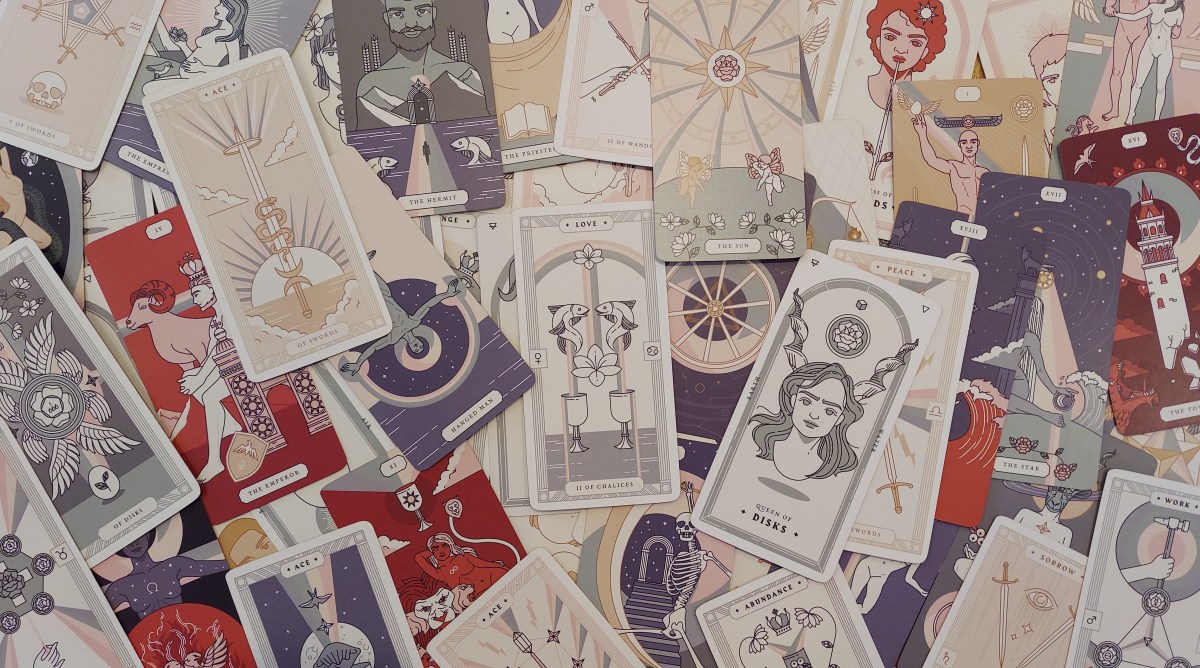
The cards themselves are a good quality cardstock, smooth and just thick enough, with edges gilded in a dazzling gold. They are a pretty standard tarot height at 119 mm, but handily thinner at only 59 mm wide, and I appreciate this as a riffle shuffler. As for the artwork, there are always pros and cons in a tarot deck. I don’t know that anyone can produce between 78 and 80 pieces of card art where the reader is consistently amazed and astounded piece after piece. This deck is, however, a lovely deck. The art is computer-generated and generally flat—that is to say, two-dimensional—with a limited color palette.
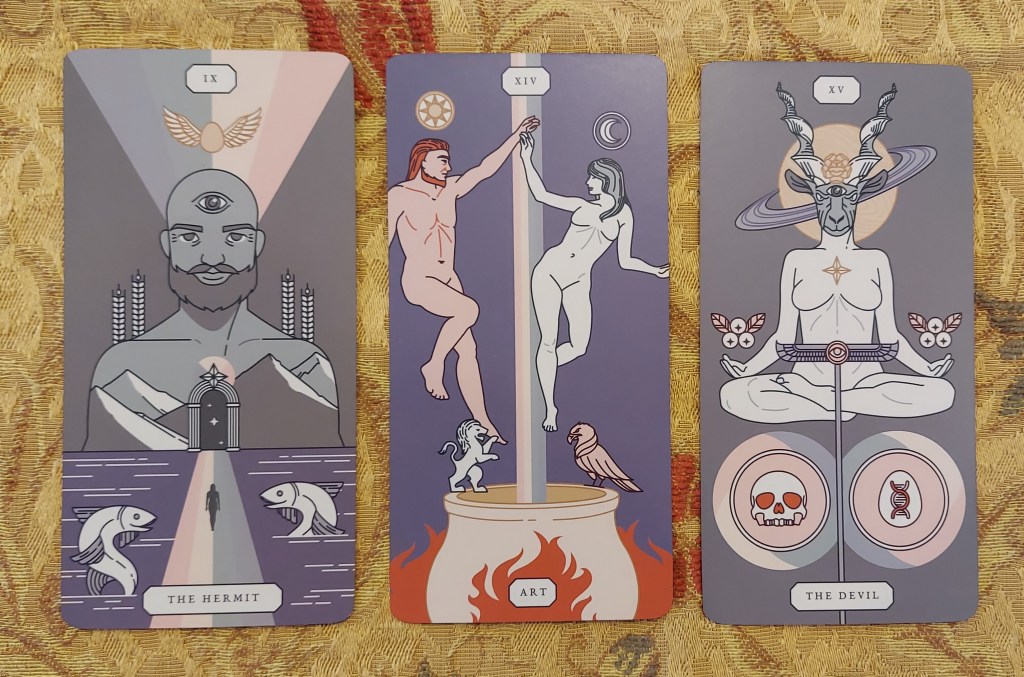
The entire deck is colored using about six distinct muted colors in various shades, dulled for what I assume is artistic consistency on the part of Gong. The title of this deck, by the way, translates from the Latin as “Secrets of the Sacred Rainbow,” and this eponymous rainbow is present on all but the sixteen court cards, where one might yet argue that the courts form their own rainbow. This sameness of hues moves into the images themselves where the consistency is nice, but perhaps less effective. To that end, the dragons destroying the Tower are the same dragon which menaces the Seven of Cups; the image of a lotus is the same image throughout the deck; any snake seen in the deck is the same snake from card to card. This practice creates a neutral aspect to the cards since the easy flow of consistent imagistic language (pro) can sometimes be counterbalanced by a loss of interest in that same consistent imagistic language (con).
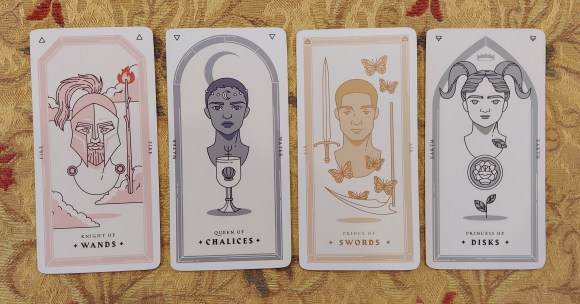
I first became aware of this deck when I noticed some of the court cards on Pinterest (and yes, I still save images on Pinterest—don’t judge me). The court cards exude that same directness and enigmatic efficiency that Gong displays in her folded LWB; the faces of her court cards are pared down to a minimum of line and image that seems at times so abbreviated that it relies as much on natural human pareidolia as the Crowleyan descriptions of the courts’ personalities. I laud this artistic accomplishment. As to the aforementioned rainbow, the courts all display the prominent color of their suit rather than the full rainbow, hence the idea that the courts are, in fact, the rainbow itself.
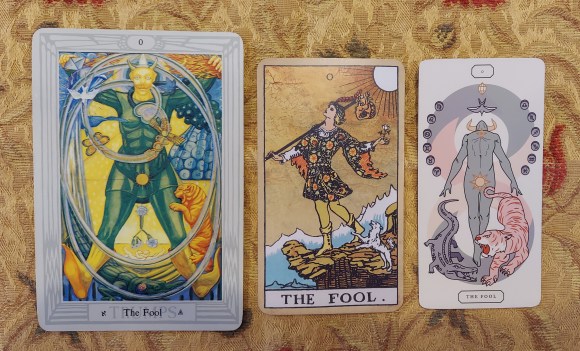
The trumps are greatly inspired by the Thoth images, but Gong does make her own artistic statement with them. The Fool is a perfect example. The Crowley-Harris Fool, beauteous and inspiring though it may be, has always been a great example of trying to say too much with an image. Gong’s Fool is neither the wandering waif nor the cliff-bound cavalier, but floats above the clash of croc and cat; in the throes of ecstasy, he is suspended from a lemniscate formed by the rainbow itself while the entirety of the Zodiac whirls around him. Call me crazy (and many have), but The Fool of the AIS appears a far more substantial illustration of the “11th path” of Kabbalistic tarot studies, the holy pontiff that connects Kether and its first emanation Chokmah than the over-busy Crowley-Harris version.
In some of the cards, I do have questions, and I always wonder if the design changes were interpretive or artistic or some combination of both. (In hindsight, perhaps I do want a little bit more than a single piece of folded vellum.) Does the Empress’s crown represent Isis or Hathor? Does it matter? Do the seven stars on her Egyptian headdress represent the seven holy planets of common astrology? The seven chakras? Was there room on the headdress for only seven stars? Something else? Nothing? In other cards, deviations are less perplexing. In the Emperor, she maintains his Arian Ram while allowing the “succulent” lamb of the Crowley-Harris image to run free. The Hierophant’s Taurean associations are still subtly present in the beige vitrail behind the figure, but once again, what are we to make of Gong’s opinion of organized religion since her Pope literally has two sinister (“left”) hands? Or was the rogue left hand just a mistake?

The cards on the whole work well artistically and collectively. In The Chariot, her replacement of the traditional conveyance with the Merkabah is well done. The Star is simply lovely. The Moon card is clearer than Crowley’s to be sure, and we can now more easily see the connection between the Moon herself and the ball of the Sun being pushed through the liquid Night by the beetle Khephra. In The Aeon, Horus’s double forms are conspicuous in their absence, but Nut herself, haloed in rainbow, calmly regards the egg of a new empire, which was always the thrust of the card.
The pip cards, too, are elegant and straightforward. Their titles are directly Thoth-based as Crowley did recast some of the wordier Golden Dawn nomenclature, and the images are generally based on the Harris designs though Gong does take some liberties for a slightly different artistic and symbolic representation of the essentially Crowleyan idea. As with the rest of the deck, the pips are lean and sleek with traditional Golden Dawn/Crowleyan astrological references consistently and plainly displayed on the minimalist columnar borders around each of the minor cards.
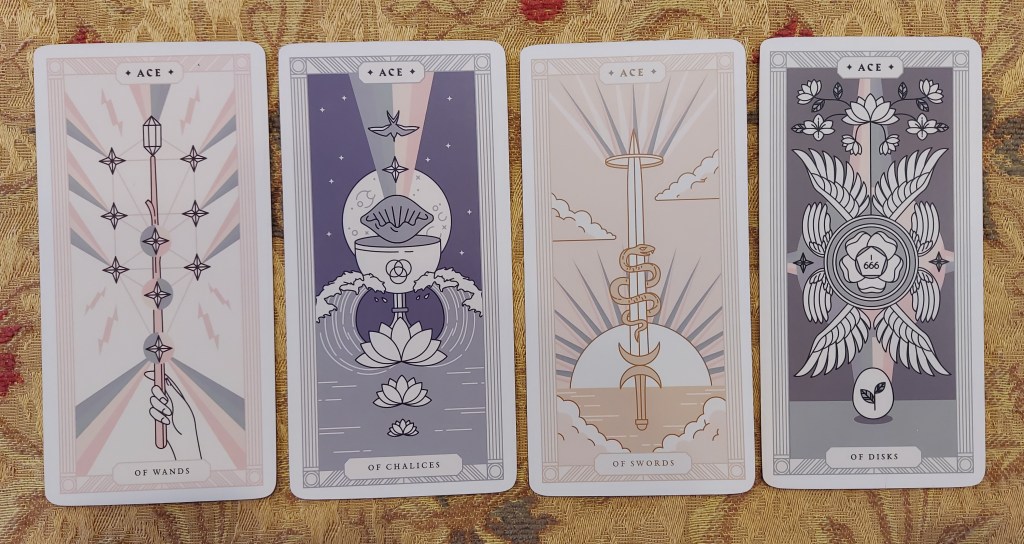

Overall, this deck is a pinnacle of production and process. The artist has thought this deck through and that research shows. If I have one negative observation—I hate to use the word “complaint”—I would have to say that for all the effort that Gong seems to have taken to “smooth over” (my words) some of the harsher elements of Crowley’s symbols and Harris’s art, I do take issue with one odd theme within this deck: Gong’s effective emasculation of the deck. In cards like The Magician and The Lovers, where the men are obviously standing nude, the reader may have been better served with . . . something, anything . . . the non-threatening outlines of Hellenic stone genitalia, a Pixie-esque suggestion from the RWS . . . something. As is, these Ken-doll castrati are more disconcerting than they would be if they were simply a bit more anatomically correct. Also, while on this subject, I must mention The Devil. The Crowley-Harris image is one of the most powerfully phallic cards in the deck, while Gong’s far more feminine Baphomet (Baphomette?) seems a kind of vague, horned Fate weighing Life (the right sphere of DNA) and Death (the left sphere with a skull). For good or ill, the menace of the Devil’s fun has been removed, and I do ponder the artist’s choices in this regard.
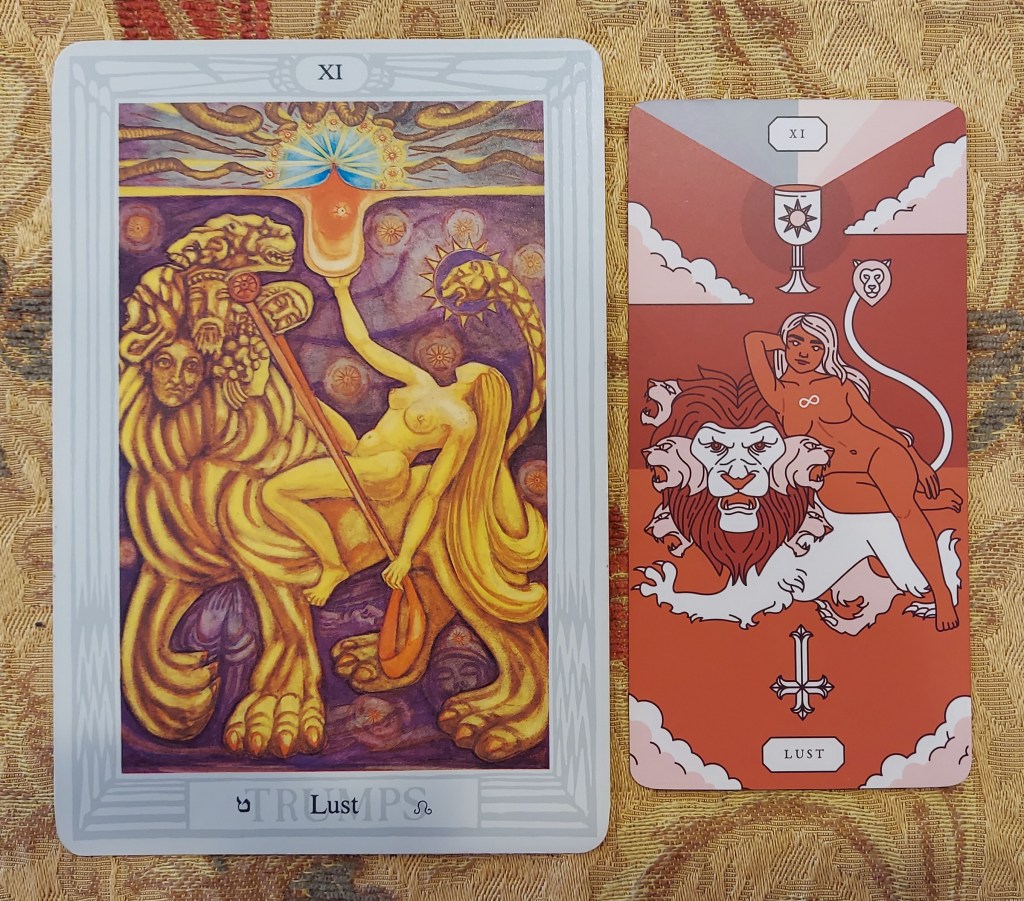
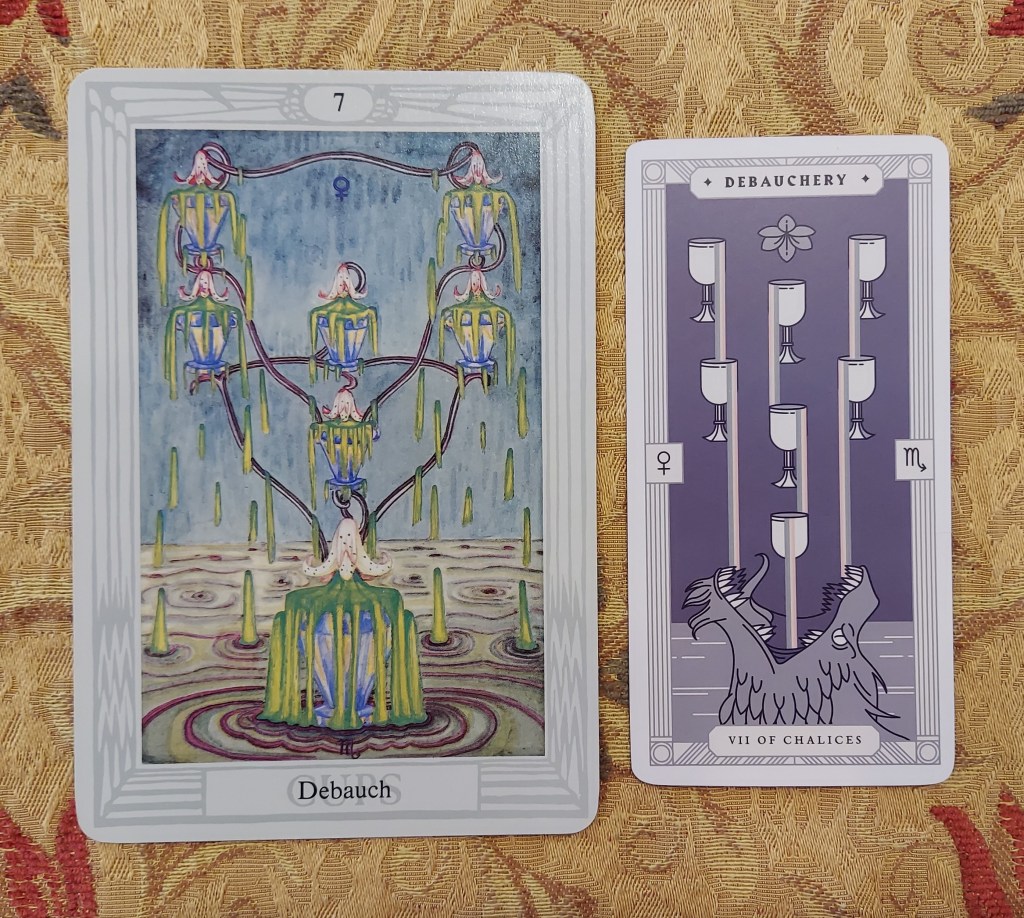

Given the obviously Thoth-based system employed in this work, another issue that begs to be addressed is the marked absence of the Hebraic and astrological or alchemical attributions associated with the Trump cards. Crowley himself goes on at length about the importance of these associations, but they are not found here. Certainly there may have been a distinctly artistic reason to avoid the associations since, unlike the pips, the trumps are borderless. Perhaps the artist simply couldn’t bring herself to perpetuate the needless exchange, Hebraically and Kabbalistically, of The Emperor and The Star and so forwent the trump associations altogether? I have no answer for this, but that alone certainly would have stopped me.
To end, I hesitate to call this deck “simply beautiful” because there is nothing “simple” about it. The beauty and effortless usability of the deck rests in Gong’s stripping away of some of the colorful and imagistic excess of the original Frieda Harris paintings. While I am an admitted devotee of the Thoth Tarot, the Arcana Iris Sacra Tarot remains a visually intriguing, focused, and meditative interpretation of one of the twentieth century’s foundational occult works, and a deck that I wholeheartedly recommend. As with her Seventh Sphere tarots and her exquisite book, I thank Tina Gong for her continued contributions to our rich and vibrant tarot community!
 The Tarot King of Mississippi