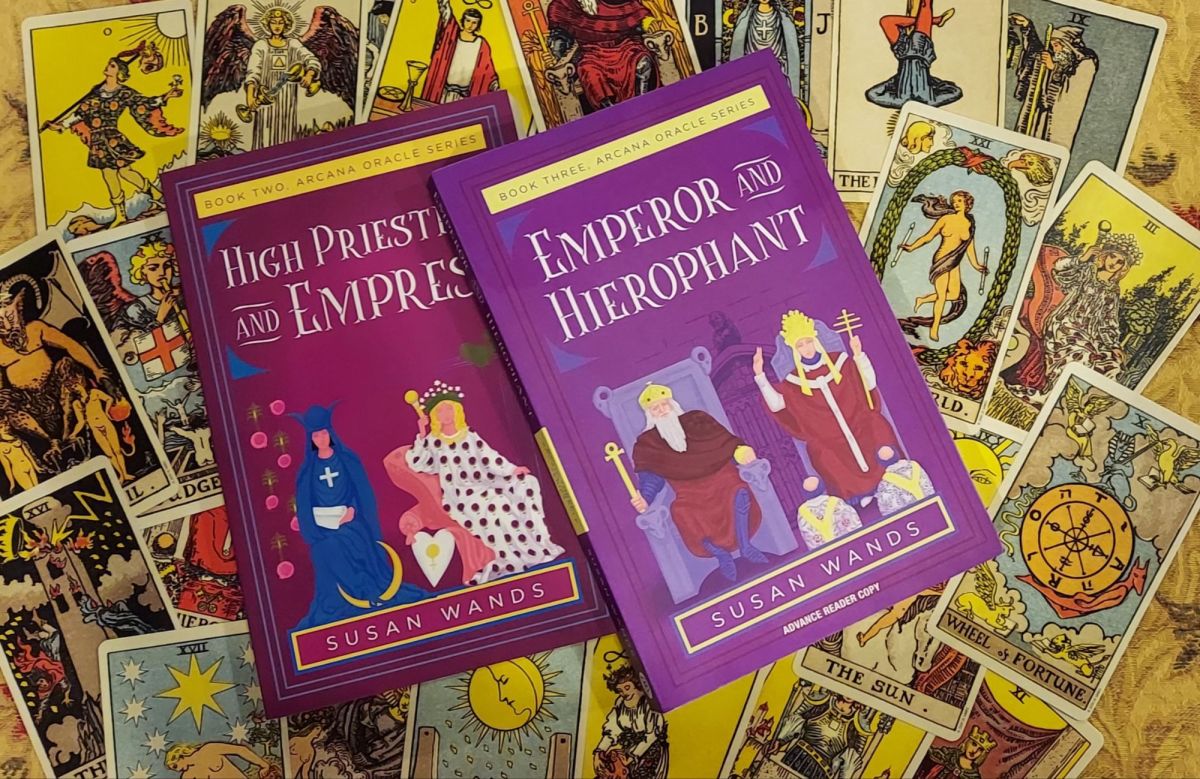
Please note that these books were sent to me at no charge for the purposes of review.
SPARKPRESS http://www.gosparkpress.com
As involved with tarot as I am, I am embarrassed to admit that I had never heard of the Arcana Oracles Series by Susan Wands. When I was contacted by SPARKPRESS about reviewing the newest volume of the series, Book Three: Emperor and Hierophant, I was thrilled. For some context for the series, I was sent Book Two: High Priestess and Empress as well, and I am truly grateful for that.
I suspect that a large portion of Wands’ readers will be somewhat familiar with tarot. Over the last century, the tarot created by Pamela Colman Smith has become the single best-selling tarot deck of all time. Since their premier in 1909, her cards, their images, have transformed the tarot. Sadly, given the socio-cultural ubiquity of PCS’s artwork, many people still don’t know much about the artist past this one project. Over one hundred years later, Susan Wands has undertaken the monumental task of fictionalizing the inspiration and creation of these cards that so many love so much. Even though these books are historical fiction, they do, in fact, imagine the lives of real people, people who lived and breathed and truly knew each other very well. And honestly, the fact that these people in particular knew each other is astounding.
Because of her father’s prestigious job and her mother’s interest in the arts, the Smith family had made many interesting friends, and when PCS was a young woman, she was sent to live with one of England’s most prominent actresses: Ellen Terry. Living in England with Ms. Terry, PCS was allowed to explore her talents and interests, so she joined the mystical Order of the Golden Dawn. At this time, several of the most popular names that we still associate with the Golden Dawn were members: S.L. MacGregor Mathers and his wife Moira, William B. Yeats, Aleister Crowley, and, of course, Arthur Edward Waite. Additionally, who managed the theater company where Ellen Terry worked? None other than Bram Stoker, the author of Dracula. All these personal associations within the actual life of Pamela Colman Smith are unbelievable enough, but Wands takes these facts and elevates them to the next level, creating a story of how these people (both real and invented) in her life inspire the tarot cards that PCS has been hired to create.
Though I did not read the first book, the second volume deftly summarizes the foundational events on which Book 2 is built, and while the same thing happens in Book 3, I was quite glad to have read the second installment. By the time a reader is three books in, the summaries don’t provide the history and relationships of these characters that one needs to appreciate their circumstances and attitudes. And speaking of circumstances, these books take place at the turn of the twentieth century in England, the final years of the Victorian Era. Wands comfortably captures the tension of personal, human relationships and Victorian social stratification and propriety, and she explains these rather complex relationships for the benefit of the modern (I daresay “American”) reader in a way that is simply part of the story.
One of Wands’ most effective strategies is having her characters converse. Susan Wands knows how to write engaging conversations that seem natural rather than expository so that the reader feels engaged with the characters without simply reading about them. I must confess that I wonder if this reflects Wands’ own involvement in theatre and acting. The old adage says, “Show, don’t tell,” but during these lovely conversations, the reader is both shown and told in much the same way that actors on a stage will describe what is going on for the benefit of the audience. In any case, I find Wands’ particular method of exposition quite successful.
These conversations also serve to flesh out these characters, giving them lives, feelings, and motivations. As she expands each of her characters, they have purpose and become a real support system for PCS as they also become the muses for her cards. Furthermore, the links between PCS and her muses change and deepen as the books progress and the threats to PCS become more determined and lethal. We are also treated to wonderfully subtle lessons in tarot cards themselves as PCS explains why she chooses certain people to represent these extraordinary archetypes.
In Book 2, as Florence Farr, actress and newly elected head of the Golden Dawn, becomes Pamela’s High Priestess and Ellen Terry becomes The Empress, the three women form a sacred bond that serves them emotionally, practically, and magically. Unfortunately, this may be where Book 3 of this series falters a bit. In Book 2, the foundations of these friendships are complex, built upon various existing links, but Wands also creates a very strong level of shared womanhood among many of the characters and the reader sees what that means to each of them. In Book 3, those dynamics are sadly absent. The reader is not surprised when PCS chooses Stoker and Ahmed Kamal (fictional Egyptologist and fascinating character in his own right) to embody her Emperor and Hierophant respectively, but what is shocking is that the relationships developed in this book are not really between PCS and her muses. Stoker and Kamal learn to understand and respect each other, but PCS is trapped in a tower for a significant portion of the book, a prisoner of her magical arch-nemesis.
Pamela’s extended stay in the castle tower does give Wands the opportunity to explore the artist’s powers in a different way. In these books, PCS is a naturally talented magician who is struggling to both understand and control her own gifts. As Book 3 circles back to PCS in her extended captivity, the young artist learns more and more about astral warfare from various spirits including a charming little afrit, but over the course of the book, these lessons become somewhat repetitive, and personally, I couldn’t help but wonder why it took so long for Pamela’s friends to find her. While there seem to be “real life” explanations for the delay, this is fiction and should perhaps have moved at a brisker pace. On the one hand, I can see that Wands needed to have PCS develop her abilities this way in order to defend herself from the clutches of her ever-growing foe, but at the same time, this is also my biggest criticism of Book 3: Let the Emperor and the Hierophant DO something. I will let readers come to their own conclusions about the degree of success Wands achieves with her final resolution, but I will admit to a bit of frustration.
My other sharp critique of the series is the villain himself: Aleister Crowley. On this point, literary critique fails me because I have been a tarot reader for over thirty years, and guess whose tarot essays I first learned with? That’s right, the Great Beast himself. I have studied some of his writings, I have read the authoritative texts on his life, and I continue to have an ever-changing relationship with him as a problematic, but ultimately thought-provoking person. I have had to accept that, for all Wands does to humanize and deepen the various sympathetic characters in Pamela’s life, she has not bothered to do that with Aleister Crowley. As a reader—not a historian or a student of Crowley—I have tried to take his character seriously and see the threat. Honestly, however, the character of Crowley that Wands has created is an audacious, theatrical, young servant of the god Thoth who comes across as more of a moustache-twirling Snidely Whiplash trying to tie Pamela Colman Smith to the astral railroad tracks more than an actual human being.
These few critiques notwithstanding, these books are very entertaining. I have appreciated the relationships that Wands has created between the various characters and how they continue to shift and evolve as the story shifts and evolves. I like how Wands portrays magic and astral work in these books as more of a mental, invisible harnessing of energies. And one thing that I think bears mentioning because it does play into the books, Wands has handled some very delicate political terrain concerning the often-problematic nature of the British Empire’s influence on and treatment of various countries around the world. Overall, I recommend this series. If the reader is a fan of tarot, of England, of the Golden Dawn, or simply of Pamela Colman Smith as an artist, then Susan Wands has created a series of books that will captivate and engross you and have you wanting more. I for one cannot wait to see who inspires Pamela’s Lovers and Chariot!
 The Tarot King of Mississippi