Creator and Writer: Rachel True
Artist: Stephanie Singleton
Published by Houghton Mifflin Harcourt 2020
Rachel True’s True Heart Intuitive Tarot has thrust me into an existential dilemma, a conflict of gross cultural proportion. We here in the Deep South value our politesse. Mississippi, for all its past flaws and indiscretions, is “The Hospitality State.” Throughout my entire upbringing, however many of those values I later eschewed, “I’s raised right.” I was taught that one does not insult someone’s baby. No. When those proud parents pull the blanket off of their little troll’s head, you keep your screams inside. You compose your face, count everything you can see on the little critter, and if the numbers add up, you smile big, look its parents in their glowing faces, and say, “Well, that’s a fine baby.” Because that’s polite. And “fine” is not technically a lie. That little chunk of ugly is of sturdy construction, and that fact is to be commended. With heavy and conflicted heart, I submit that the True Heart Intuitive Tarot is a “fine” tarot set.
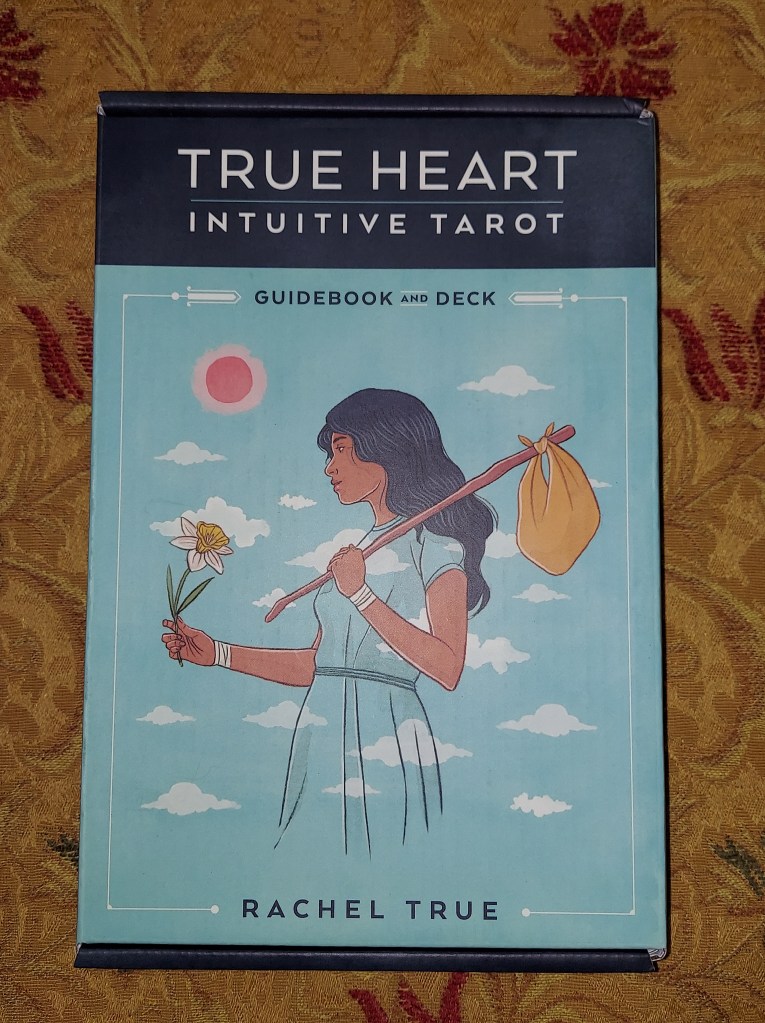
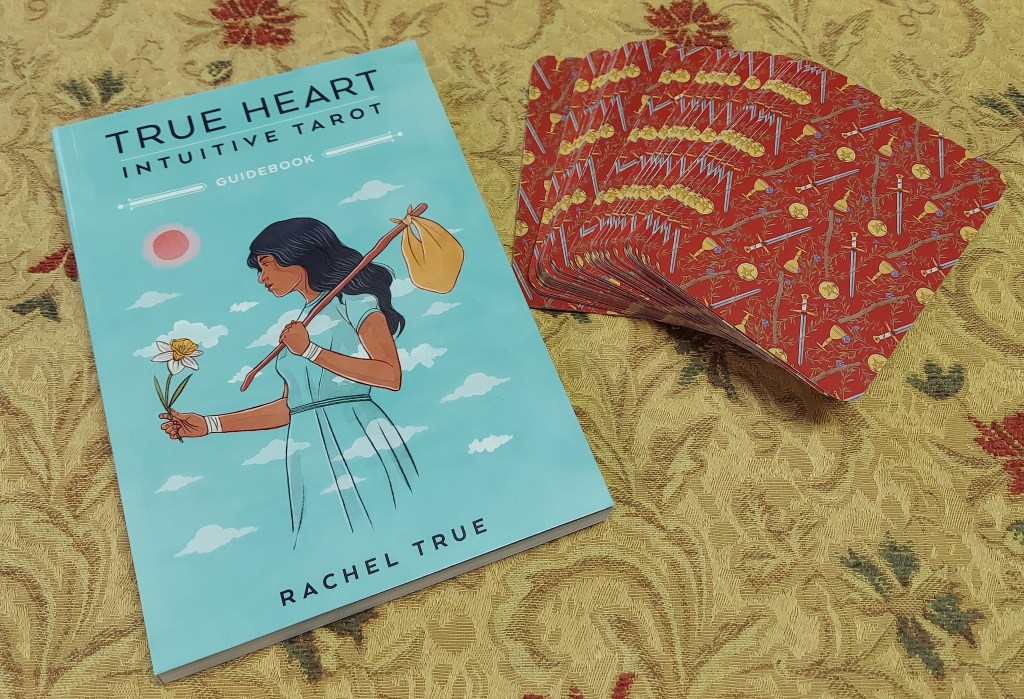
Overall, I appreciate True and Singleton’s contribution to the tarot. Although I admittedly am no hard-sell when it comes to tarot, the box is inviting with its ethereal Fool and perfect blue-green color. I admit that I did pause at the price tag at the bookstore and ended up cheaping-out through Amazon at literally half the cost. Once the box is opened, one finds a repeat performance of the box on the book, a good choice since the image is quite eye-catching. Rachel True’s book is no “LWB,” but a fiveish-by-eightish-inch novella of just over two-hundred shiny, glossy pages. The book’s more tactile properties reminded me of old textbooks, new from the publisher, still scented with that coolly produced, chemical aroma. As for the content of the book, after some introductory material about the tarot itself and some spreads, True carries her breezy and conversational style into the cards. Rather than “Upright and Reversed” meanings, she presents “High Vibe” and “Low Vibe” interpretations. Her “high and low vibes” are a nice and non-threatening take, but her actual definitions of the cards themselves add nothing for me as they are gently reworked Waite-inspired essays capped with a personal connection. There are also many pop culture references designed to pull the reader closer to the read like her stories about working on The Cosby Show or the movie The Craft. She also compares the High Priestess to Doctor Who (55).
It pains me to admit that I did not finish the book. Approximately one hundred pages in, I couldn’t go any further. And by the time I had reached one hundred, I was skimming hard. True indulges little “tarot notebook”-style personal revelations about each of the majors, relating an experience from her life to the individual cards. As for her personal vignettes, the ties to the cards vary in strength, and by the time I reached the Hanged Man, I just didn’t want to read them anymore.
On a more pedantic note, my petty grammarian’s heart would not let me ignore the fact that she consistently refers to the cards and the person in them as “they.” As introduction to the Magician, True writes, “The Fool started with nothing; they leapt off a cliff, and whatever their journey, they have matured in their knowledge” (49). I think that I see where she was headed in this inclusive pronoun—we’re all the Fool, aren’t we?—but…I just can’t. My soul has not yet evolved to that point.
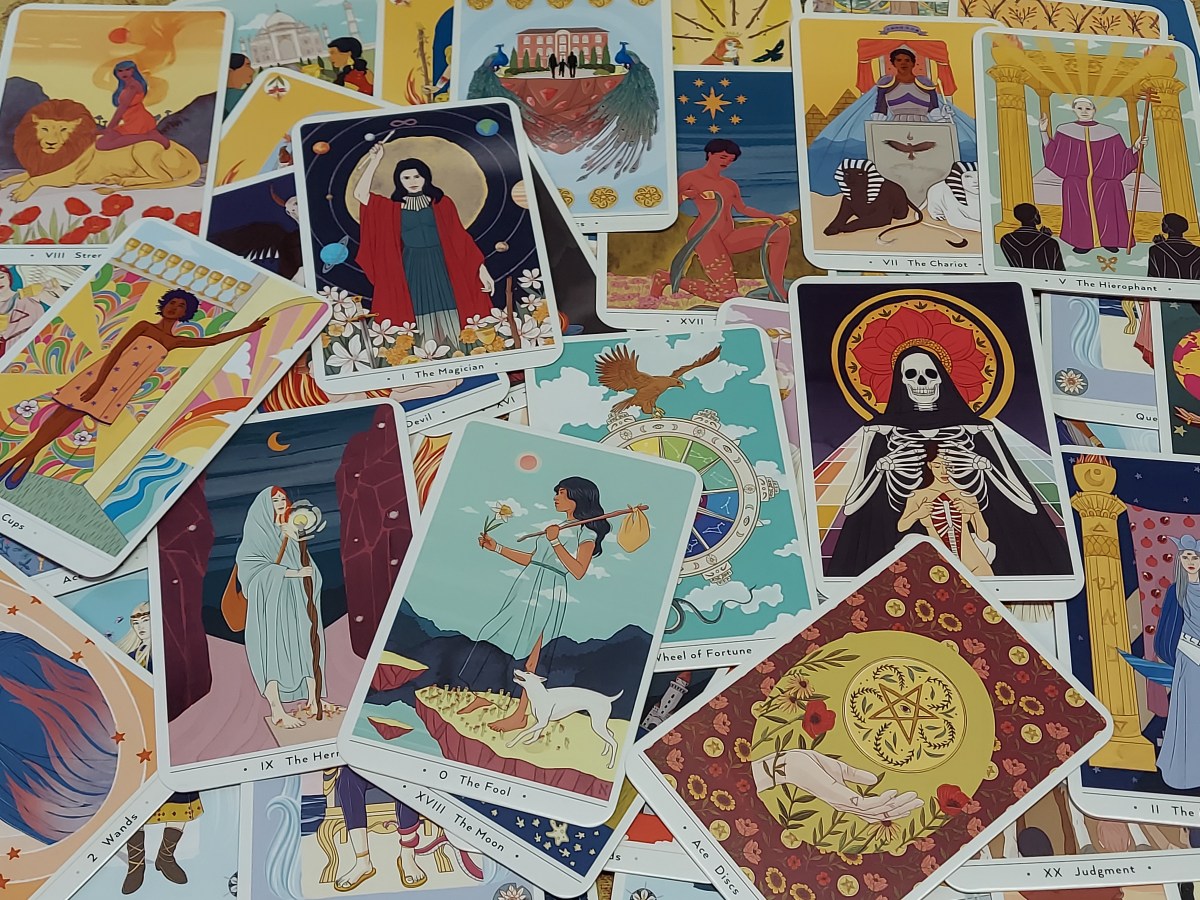
The cards in this set are…“fine” as well. Roughly the same height as the standard RWS, but a little wider, they are a thinner stock that shuffles well now, but given some use, will probably become worn rather quickly. The great majority of the images are really delightful with artistic and cultural references throughout. I think Stephanie Singleton did a nice job producing some nice images. The backs are reversible, but decorated in an unfortunate wallpaper-like design that adds nothing to the cards. After seeing this, if given the choice of some household item on which to base the backs of tarot cards, I prefer Persian rug-based backs to wallpaper themes.
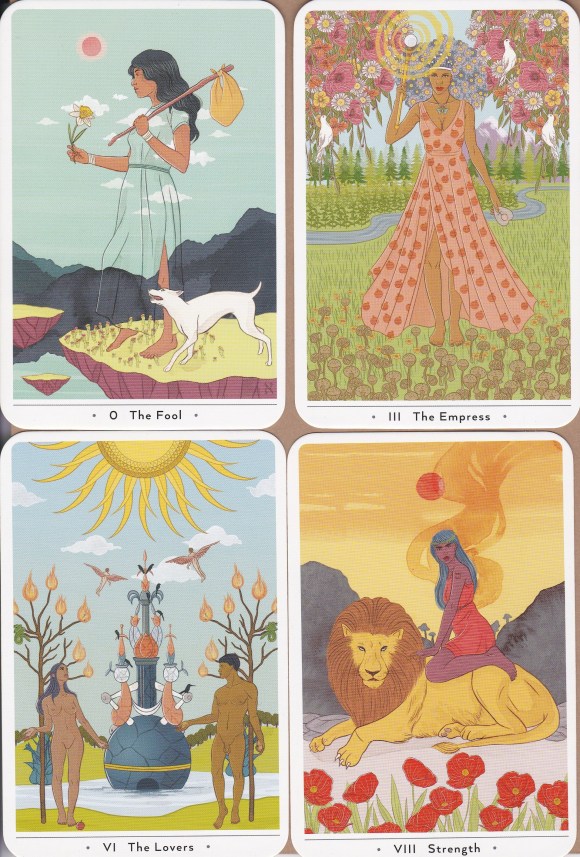

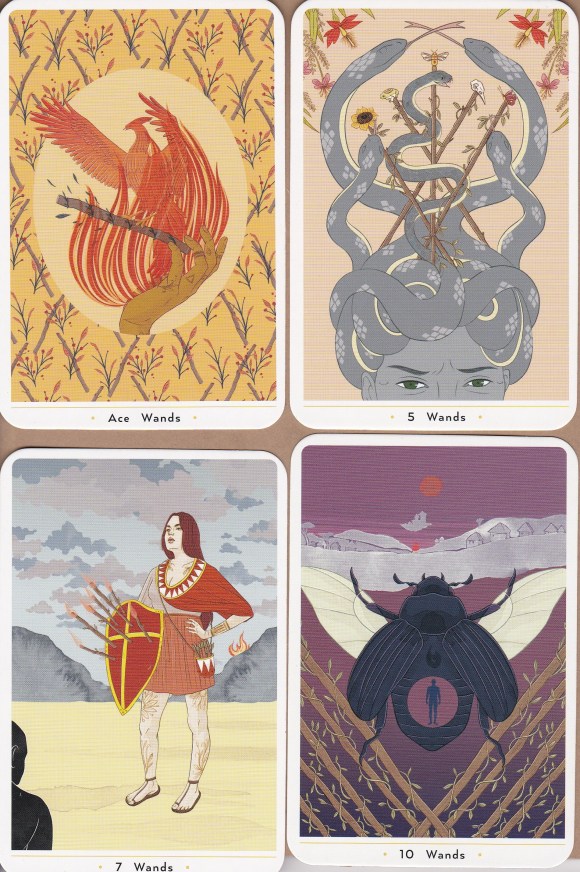

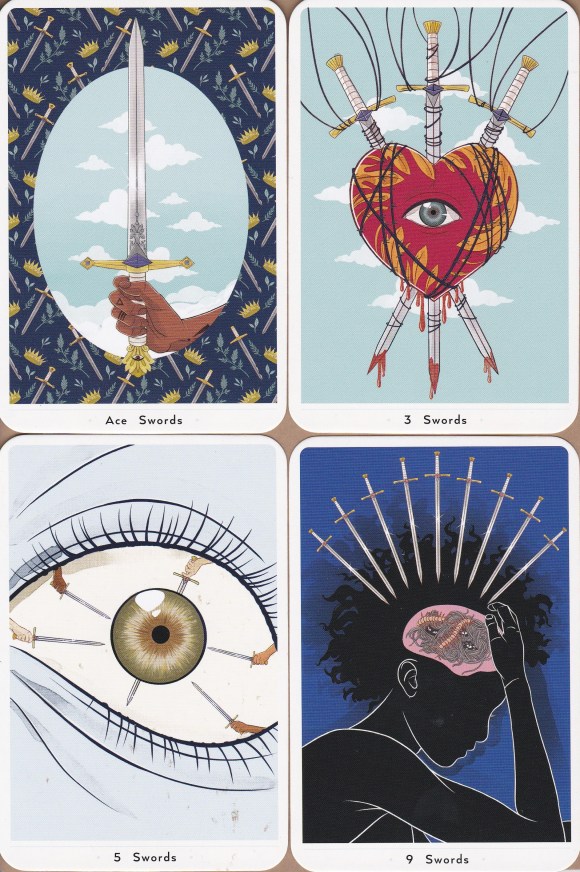
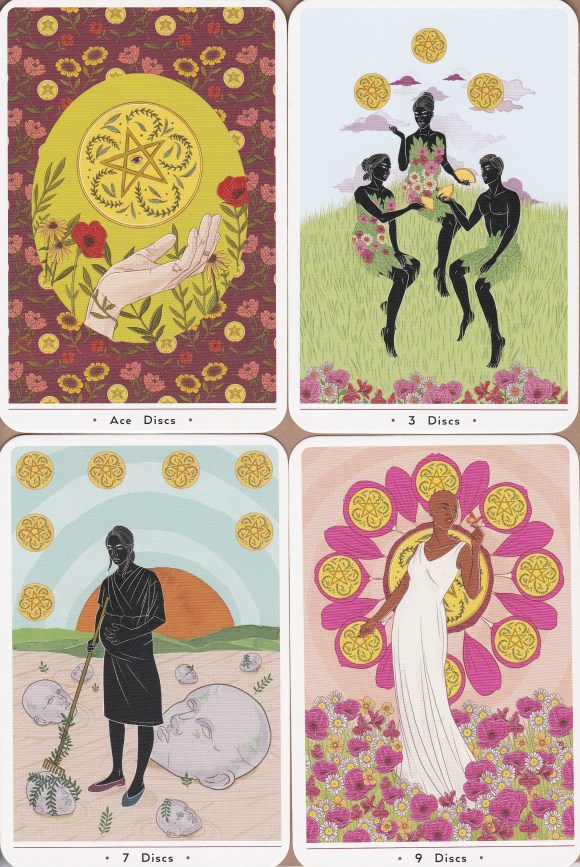
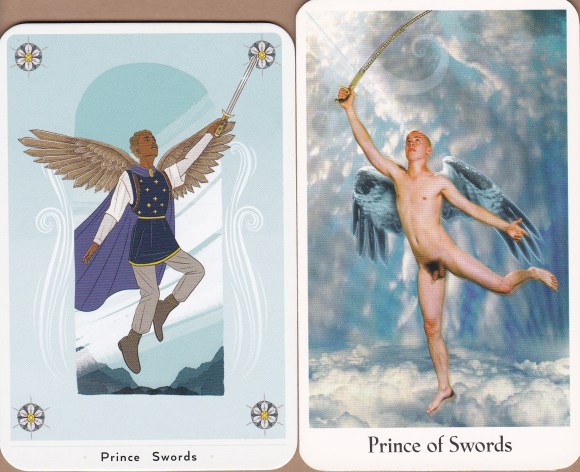
The cards themselves can be read immediately, especially if the Practitioner is familiar with the RWS system. Singleton seems to have based her pieces essentially on the RWS imagery or at least meanings, but there are touches of other influences here and there. True Heart’s Lovers stand not necessarily in Eden, but in a Boschian Garden of Earthly Delights; the lovers in the Two of Cups stand appropriately before the Taj Mahal, the greatest symbol of love that any mausoleum could be; and the Prince Swords is, for my money, soul-brother to the Prince of Swords from the Cosmic Tribe Tarot. I appreciate that Singleton has done her homework, both artistically and with regard to the tarot.

The images are generally harmonious in a spread. The cards speak, not scream; there is a calmness throughout the colors and images of the deck, and even some of the most potentially visceral images in the tarot, like the Devil, have no real threat. For example, on first glance, the Devil may look menacing, but then we start to notice the odd angle of the hands, the computer-repeated skulls on the garment, and the fact that Death is randomly holding a cow. No reason is offered either by artist or by writer. Sacrifice, maybe? I don’t know. (Addendum 09 Sept. 2023: But Jay Wheeler does! See response at the end of the post. Thanks, Jay!)
The cards also showcase a hodgepodge of races, ethnicities, and cultures. The deck is diverse in the fact that there are many shades of people, but while it appears that Singleton tries to have a cultural theme in the Courts, I did not recognize any particular culture or people nailed down. The Courts are uniformly lovely, but if a system was attempted, I fear it breaks down upon closer scrutiny. The Courts also have a flower motif: one finds a flower in the four corners of every court, one flower per suit. Botanical knowledge being limited, I did not immediately recognize the flowers or any potential significance they may possess. On the whole, the cards lead us in directions where they do not go.
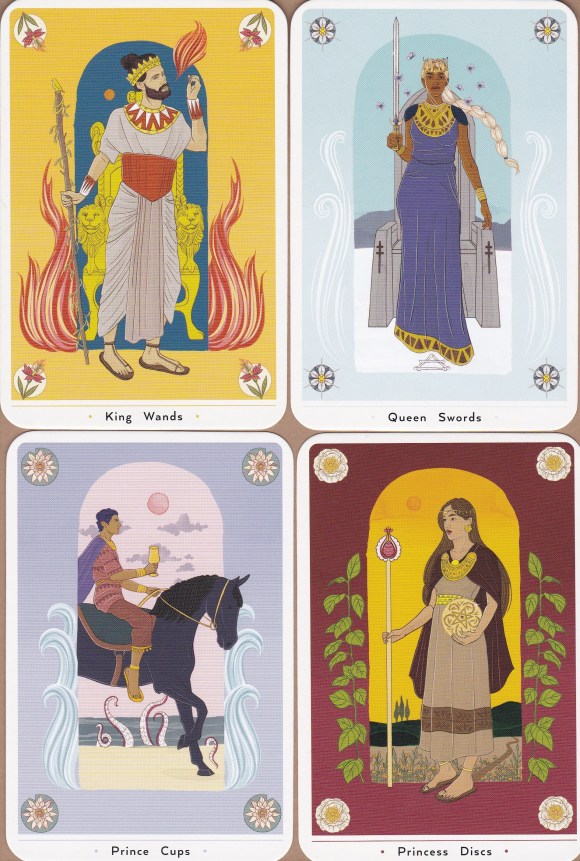
The disconnect I have had with this book-deck package brings to mind an aspect of the book-deck model that I have only now been able to concretely identify. Especially in a set that is as book-heavy as this one is, an accompanying volume must explain the cards. One of my greatest disappointments in this set is that True does not talk about the cards that are being sold with her book. Did she design them? Did she guide the artist in a rigorous Crowley-Harris-type exchange? Did she have any input at all? I can’t tell. With very few specific references throughout the book, her book could have referred to any and all RWS decks or clones, but what I wanted True to do was explain to me why the Devil is holding a cow. (Again, see Jay Wheeler’s response below.) I want to know why various figures in the cards are standing in mushrooms. I want to know what those flowers are in the foreground of Strength and what all those flowers are in the corners of the Courts. I want to know more about the cards than True is giving. I don’t mean to seem unkind—hard to believe at this point, I know—but tarot card buyers (or maybe it’s just me) are usually buying for the cards, and the book is a pleasant extra. This set seems a rather corporate reversal of that.
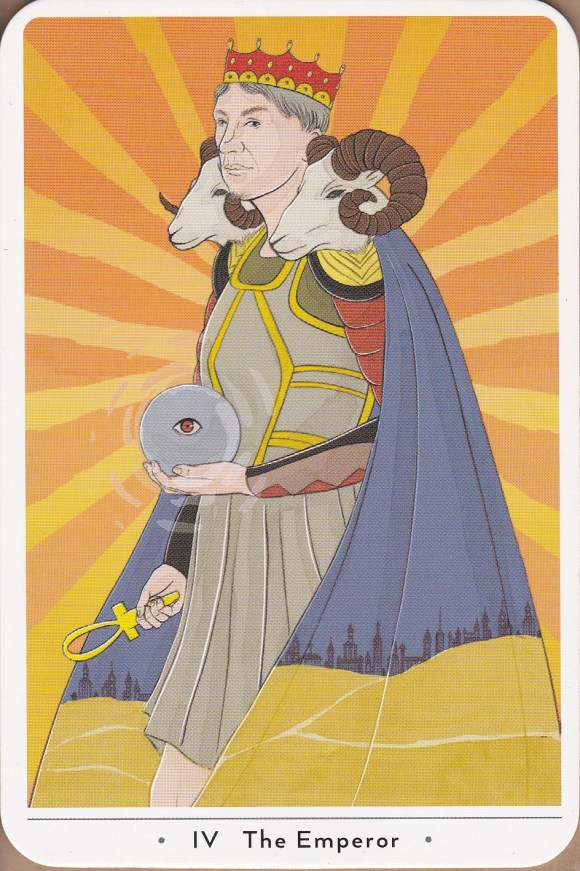
As a final note, it pains me to the core of my Southern soul to suggest that this baby is ugly, but there is hope, and if there is a second edition of these cards, let me make just a couple of well-meaning suggestions. First, take those ridiculous ram heads off the Emperor’s shoulders. Second, make the cards larger; they suffer from line quality and image issues that I think a larger format would solve. But I still like the cards and I appreciate what True is doing. Her tone doesn’t resonate with me, but I am sure there are many to whom and for whom she speaks with forceful voice, people who want to know Rachel True and get some insight into the tarot as well. To those people, I heartily recommend the True Heart Intuitive Tarot.
 The Tarot King of Mississippi
5 replies on “Review: True Heart Intuitive Tarot”
I hear you about the not-so-LWBs… The more deck reviews I read and view, the more I think I’ll stick with traditional RWS, TdM and Thoth.
LikeLiked by 1 person
This blog article was such a fun read! The author’s witty commentary and humorous anecdotes about Southern hospitality had me chuckling. While the True Heart Intuitive Tarot set may not be their cup of tea, the review was thorough and honest, providing valuable insight for anyone considering purchasing the deck. I appreciated the author’s attention to detail, even down to the design of the card backs. All in all, it was an entertaining and informative review!
LikeLiked by 1 person
The Devil is holding a golden calf, symbol of materialism and idolatry, which is perfect for Key XV.
LikeLiked by 1 person
Jay! Thank you so much! Your answer to my question really puts my mind to rest on that nagging matter. Thanks again!
LikeLike
[…] https://tarotkingofms.wordpress.com/2021/05/12/review-true-heart-intuitive-tarot/ […]
LikeLike